Pressing the SOS button on a personal locator beacon (PLB) or a satellite messenger sends a distress signal with your position. What happens next differs: who receives the alert, whether anyone can ask you a question, what keeps the device running, and how well it works for someone floating in cold water. The personal locator beacon vs satellite messenger question is easier to answer by running both devices through two emergencies than by comparing spec sheets.
The first emergency is a crew member in the water. The second is a boat that is taking on water too slowly to abandon at once. Each device has a job in one of these and a weakness in the other.
Two Ways to Call for Help: Who Actually Receives Your Alert
A PLB transmits on 406 MHz. Cospas-Sarsat satellites pick up the signal and pass it to ground stations, then to a mission control center, which forwards it to the rescue coordination center responsible for your position. If the beacon is registered, the unique ID in the signal lets the coordination center look up your details, usually including emergency contacts. Many PLBs also send a weaker 121.5 MHz homing signal that search aircraft and rescue craft can steer toward at close range, and most carry a strobe.
A satellite messenger works through a commercial network. The handset sends the SOS to the provider’s emergency response center, staffed by the provider rather than a government agency. That center contacts the rescue coordination center for your location. That extra link in the chain enables two-way contact: the center can text you back, ask how many people are aboard, and pass your answers to rescuers.
Two points apply to both devices:
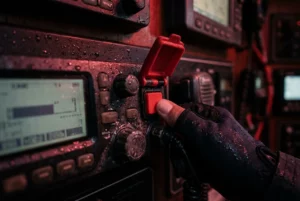
- Neither one alerts the boats around you directly. A ship ten miles away does not hear a PLB or a messenger. It hears about you only if the rescue coordination center broadcasts a relay. For nearby vessels, the radio is the tool. The article on marine VHF features that help when you are calling for help covers DSC and the settings that matter.
- The details of the chain depend on the model and the provider. The manufacturer’s service terms cover which satellites carry the signal, how often a messenger reports position after SOS, and what the response center does when it cannot reach you. Read them before you buy.
For the beacon side of this decision, see EPIRB vs PLB. It covers the boat-mounted version of the same 406 MHz system.
Man Overboard Test: What Each Device Does in the First Hour in the Water
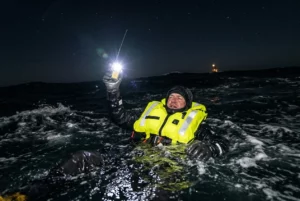
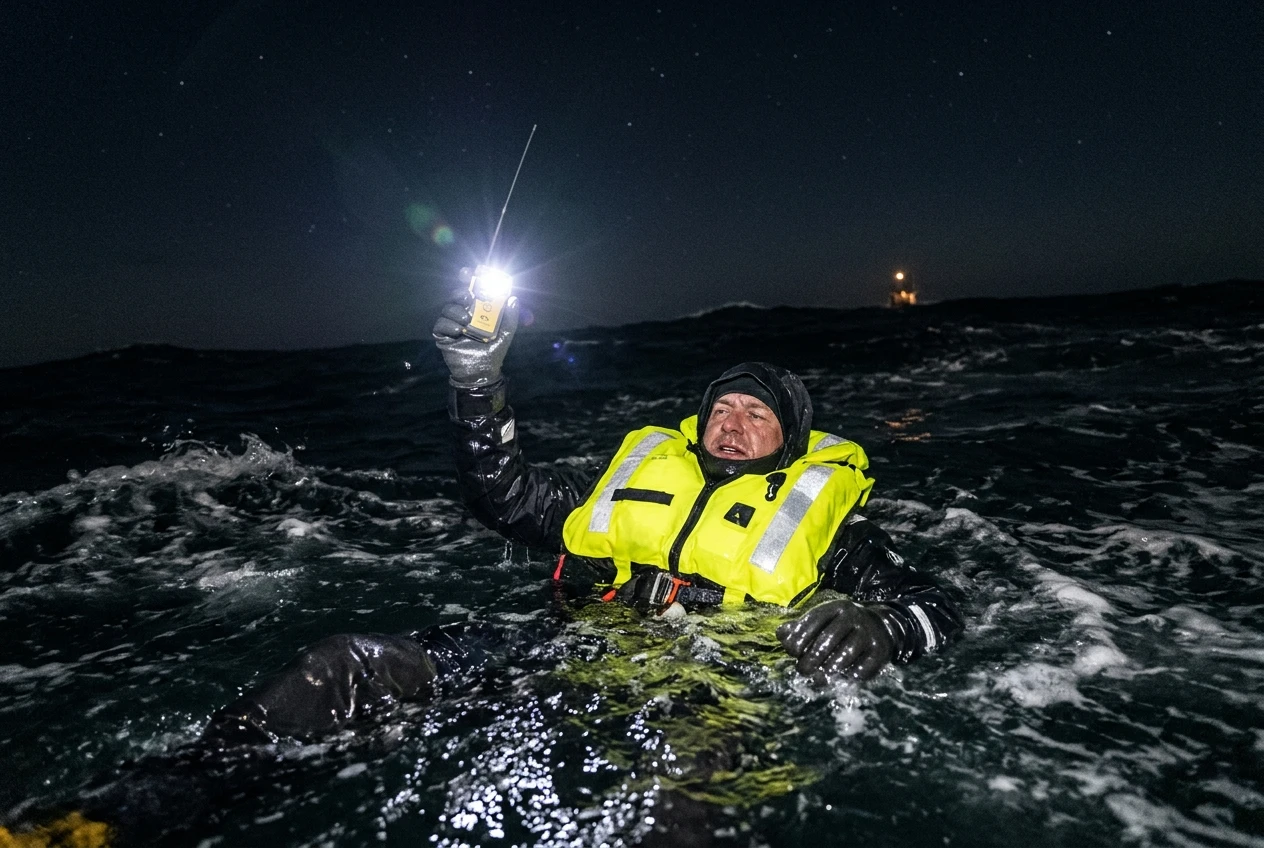
Take the case where the device matters most: someone goes over the side at night on a short-handed boat, and nobody sees it happen. The boat keeps sailing. The person in the water has whatever they were wearing.
In cold water, a person loses grip strength and fine motor control within minutes. A device only helps if you can use it with numb hands, possibly in gloves, while waves break over your head. That is the test.
The PLB in the water. You usually arm a lifejacket-mounted PLB by pulling the antenna out of its stowage and pressing or sliding an activation control. Some lifejackets with a dedicated PLB pocket or fitting make this easier, and some are designed to trigger the beacon when the jacket inflates. Check whether your jacket’s model supports this rather than assuming it. Once activated, the beacon transmits continuously without further input. The person’s job is to stay afloat, keep the antenna pointing up with as much clear sky as possible, and wait.
A PLB with a GPS receiver includes its position in the 406 MHz message. Without GPS, the satellites calculate a position from the signal itself, which is less precise and can take longer to resolve. Buy a GPS-equipped model, because the position error matters when the search area is a dark sea.
The satellite messenger in the water. A messenger usually needs a GPS fix before its first SOS position is useful, and it needs clear sky to talk to its network. The SOS button often sits under a protective cover. Messenger screens and buttons are small, and sending a typed reply from the water is close to impossible. Even if the SOS goes out, the device’s useful part, two-way text, will mostly be out of reach for the person wearing it.
Messengers also have a practical problem as a lifejacket accessory. Many are larger than a PLB, many are designed to be clipped or carried in a pocket, and not all float. If the wearer loses the device when they enter the water, it does nothing.
What the first hour looks like. A PLB activated within a minute or two sends its alert, and the satellite network typically detects it within minutes when the signal includes a GPS position. The coordination center then has a registered vessel to look up and contacts to call, so someone can start the process of finding the boat even if the wearer cannot speak. A messenger SOS depends on the unit holding a fix and reaching its network, with a staffed center then taking over.
For a person in the water, the PLB has fewer steps and fewer failure points. That holds for the wearer. The boat can still carry a messenger for crew who aren’t in the water.
Two-Way Messaging When the Boat Is Sinking Slowly, Not Suddenly
Reverse the scenario. Nobody is overboard. A through-hull has failed, or the boat has hit something and the bilge pump is failing. There are hours, perhaps, rather than minutes. The crew is on deck and dry enough to use their hands.
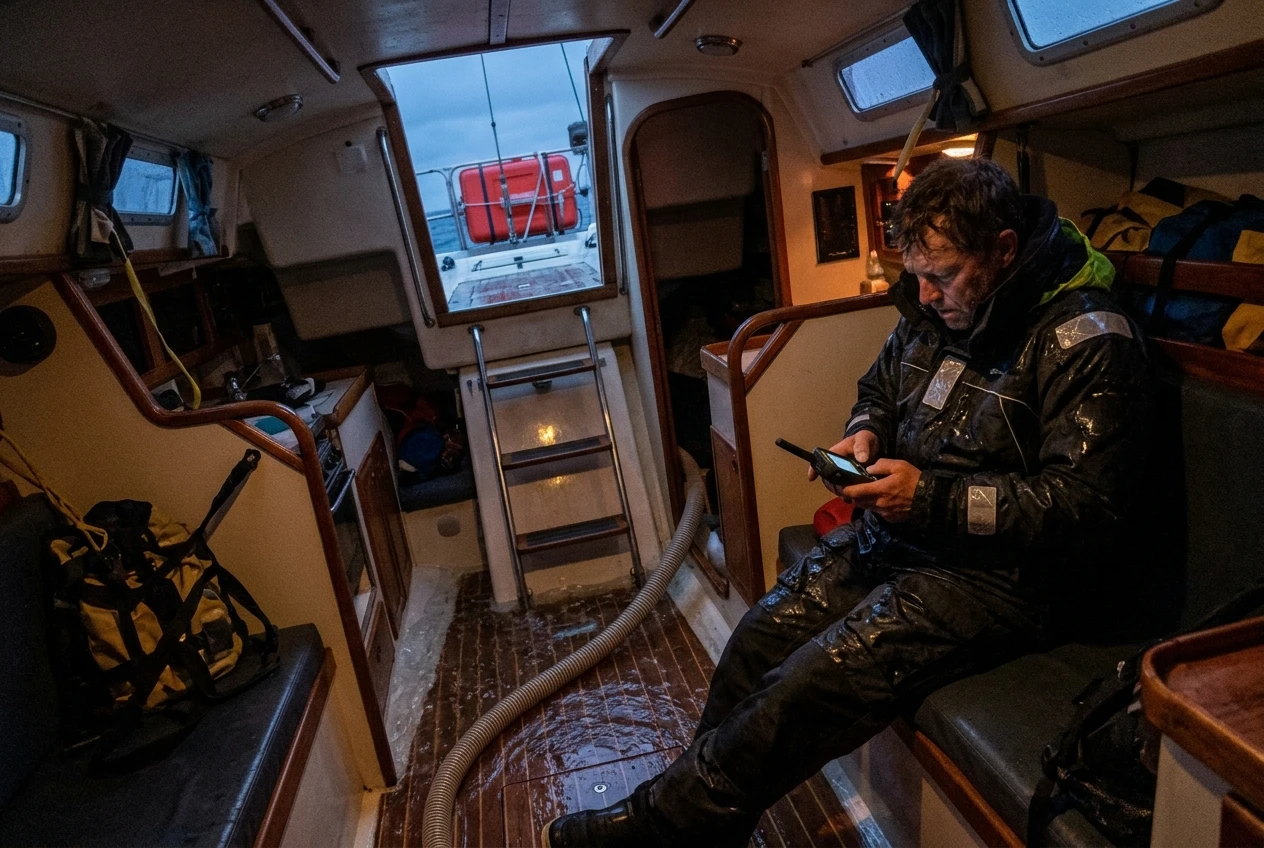
This is where a satellite messenger earns its place. A PLB sends one message: a distress at this position from this registered beacon. The rescuers know nothing about the situation until they arrive or reach you by another route. A messenger lets you tell them:
- how many people are aboard and whether anyone is injured
- what has failed and whether the pumps are holding
- whether a life raft is ready and what other safety gear is available
- what the weather is doing and whether you are drifting
- whether a ship has already been diverted, and its estimated arrival
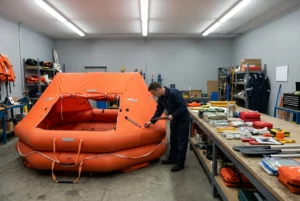
You can also receive questions and updates. A responder can tell you a vessel is on the way, ask you to confirm a position, or tell you to stay with the boat while the situation is assessed. That information changes decisions, such as whether to launch the raft now or keep bailing. The article on what an ISO 9650 life raft pack contains covers the raft decision.
A messenger also gives you a step before the full SOS. A text to a shore contact saying “taking on water, pumps coping, will update in thirty minutes” starts the people on land thinking and checking the weather while you still have options. Once lives are at risk, send the SOS without waiting for the situation to worsen.
Some newer PLBs can receive a return acknowledgment, a signal confirming the satellite system received the alert, typically shown by an indicator on the beacon. That tells you someone has the alert, which is valuable, but it is not conversation. Check whether a particular model has this feature before counting on it.
Use the VHF radio first when any vessel could be within range. A mayday on channel 16 can reach a boat minutes away, and it works without a subscription or satellite.
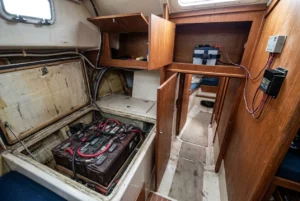
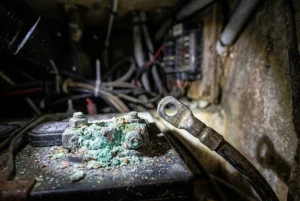
One more consideration is power. A slowly sinking boat usually loses its electrics, including the charging outlets that keep a messenger topped up. A messenger charged only from the boat is only as reliable as the boat’s wiring, which is why safety electronics die with the house bank.
What You Pay After the Purchase: Registration, Plans and Lapsed Subscriptions
A PLB has a purchase price and then very few ongoing costs. A satellite messenger has a purchase price and an ongoing service plan. Over several years, the totals can differ considerably, so work out the cost over the period you expect to keep the device.
PLB costs:
- Registration. A 406 MHz beacon must be registered with the authority in the country that coded it. The fee depends on the country, and in some places it is free. Registration is what links the beacon’s ID to you and your emergency contacts. An unregistered beacon will still send an alert, but the rescuers know much less.
- Updating the registration. Update it when you sell the beacon, change your phone number, or switch boats. Registration often must be renewed on a schedule set by the national authority.
- Battery replacement. The battery is sealed in and has an expiry date on the label. The manufacturer or an approved service center replaces it, typically on a multi-year interval stated in the manual. Plan for that cost.
Satellite messenger costs:
- A service plan. Plans are usually monthly or annual, with different tiers for message volume and tracking frequency. Some allow you to suspend service when you are not sailing, and some charge an activation or reactivation fee. Check the terms for the plan you would actually use.
- Messages and tracking points. Plans typically cap them, and overage charges can apply.
- The lapsed plan question. Find out in writing what the provider does with an SOS from a device whose plan has lapsed or been suspended. Do not assume it works, and do not assume it does not. Providers differ, and you should plan for a device in a drawer with a lapsed plan.
The practical consequence: you can buy a PLB and forget it between expiry dates, while a messenger needs someone to own the account. On a boat with several crew carrying devices, decide who holds each account and when the plans are checked. The article on which satellite communicator or sat phone to carry offshore goes into the plan structures in more detail.
Battery, Antenna and Waterproofing Details That Decide Whether It Works When Wet and Cold
Most failures are mundane: a flat battery, an antenna that cannot point up, a seal that leaks, a switch that needs fingers the wearer no longer has. Check these before you compare features.
Battery.
- PLBs must operate for at least 24 hours at very low temperatures under the standard. The sealed battery is not user-serviceable, and you should not rely on a beacon past its battery date.
- Self-test a PLB as the manual directs, which is usually monthly or before each passage, and no more often. Each test uses a little of the battery, and some models limit the number of tests.
- A messenger has a rechargeable lithium battery that loses capacity in the cold and drains faster with frequent tracking. Look for the rated runtime at the tracking interval you plan to use, not the best-case figure. Charge before every passage, and carry a way to recharge it that doesn’t rely on the boat’s main bank.
Antenna.
- A PLB’s antenna must point upward with a clear view of the sky. A beacon floating on its side in the water, or held against the chest under a spray hood or a tight pocket, transmits poorly. Read the manufacturer’s instructions for how to hold or float it, then rehearse that posture with the lifejacket on.
- A messenger’s antenna is built into the case, so orientation still matters. It needs open sky, and a unit in a bag below decks may not get a fix at all.
Waterproofing and flotation.
- Look for the rating in the specifications. An IPX7 rating means the unit survives temporary immersion to a stated depth for a stated time under test. It doesn’t mean the device is built to spend hours in the sea, so a PLB built for that purpose is a safer choice for the wearer.
- Check whether the device floats. If it does not, it needs a lanyard that can be attached to the person, and a lanyard that can snag during an escape from a flooded cabin deserves thought.
Operating it with cold hands. Put the lifejacket on in the cockpit, put on gloves, and run the device’s self-test using the same movements as a real alert. If you cannot do it quickly, a good purchase won’t help in an emergency.
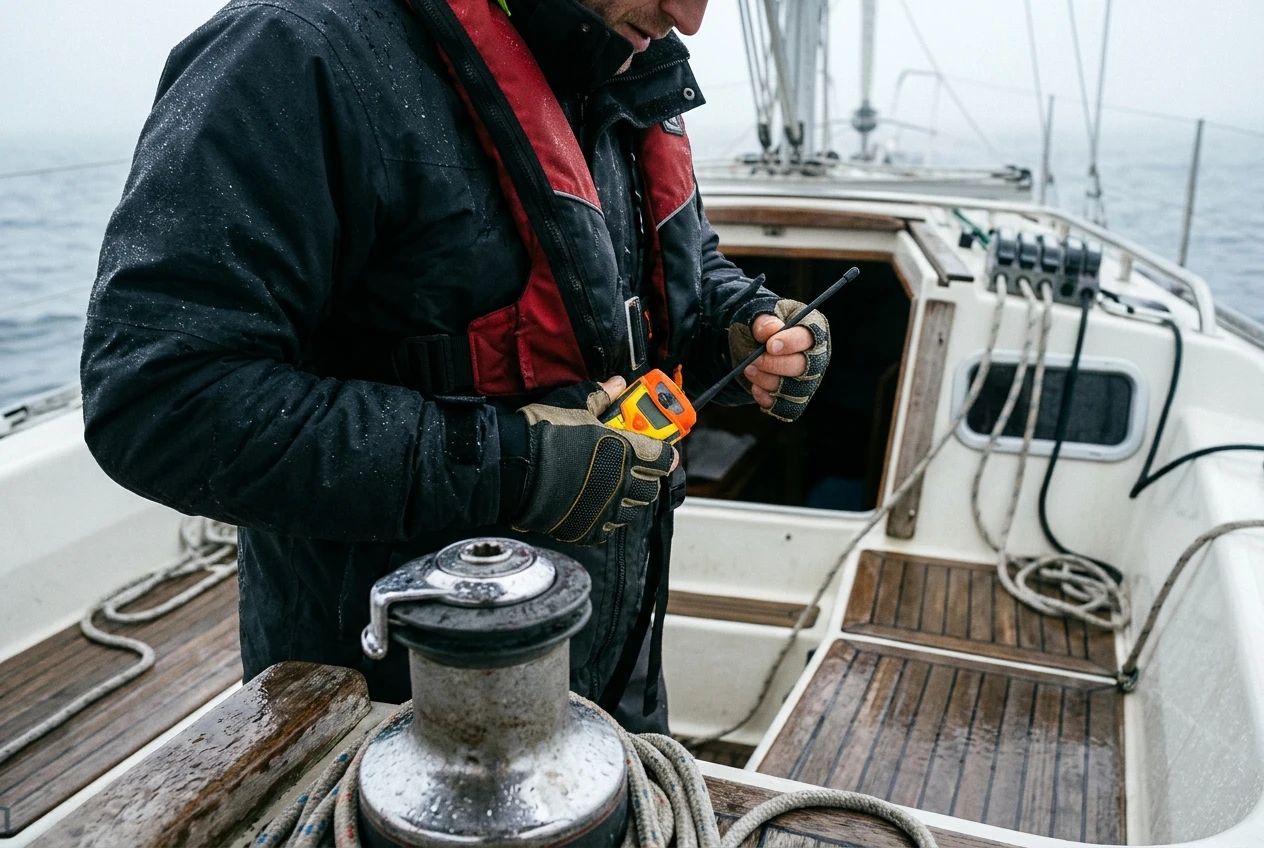
Where Each Device Lives: Lifejacket, Nav Station, Grab Bag
Each location has a job, and a device that lives in the wrong place fails to do it.
On the person (lifejacket). Put the PLB here. It is attached to the wearer, small, simple to operate, and has no account to maintain. Fit it to the lifejacket as the manufacturer allows, ideally in a dedicated pocket or fitting that doesn’t block the antenna. A PLB stored in the nav station helps only people still on the boat.
On deck or in the cockpit. A messenger works well within reach of the helm, in a pocket or on a charging lead near the companionway. It is useful for routine messaging, weather, tracking, and slow-sinking scenarios, and the person on watch can use it without going below. Its value drops quickly if it sits in a drawer that takes time to reach.
At the nav station. Use this as the charging base, not the storage place. A messenger plugged in here is charged and ready, and the shore contact can see its tracking. But if the cabin is flooding or the crew has to leave quickly, anything left here is out of reach.
In the grab bag. Put a device here that will leave the boat with the crew. Keep a second PLB or messenger in a waterproof pouch with a charged battery, ready to go in the raft. The grab bag device should be easy to use with limited handling. See the raft article for the rest of what goes in the bag, and the essential sailing safety equipment checklist for the full list of gear to carry before leaving the dock.
Do not use a single messenger as all three. If it is clipped to one crew member, it is not in the grab bag, and if it is in the grab bag, it is not helping on deck.
A Carry Plan by Crew Size and Passage Type, and When to Carry Both
Start with the boat. An EPIRB registered to the vessel is the boat’s primary distress beacon. The decisions below focus on the people and on adding two-way contact.
Coastal and day sailing, crew of two to four, within radio range.
- A PLB on each lifejacket worn at sea, if the budget allows. If not, put them on whoever is most likely to be alone on deck at night.
- A messenger is optional. A charged phone, a VHF with DSC, and an EPIRB cover most risks close to shore.
Offshore passages, couple or small crew.
- One PLB per person, on the lifejacket. With two people on watch alternately, each person is alone on deck for hours, so each needs one.
- Keep one messenger at the helm or in the cockpit, with the plan active.
- A second beacon or messenger in the grab bag if the budget allows.
Single-handed sailing.
- Wear a PLB on the lifejacket at all times on deck. A solo sailor who goes overboard has no one aboard to notice.
- Also carry a messenger, with a shore contact who knows what a stopped track means and what to do about it.
- Remember that a boat sailing on without its skipper takes the messenger with it, unless it is on the person.
Larger crew on ocean crossings.
- PLBs for the watch-standers on deck, at minimum. Everyone on night watch is a candidate.
- A messenger for communication and weather, plus a spare in the grab bag.
- Agree before departure who has the messenger account, who sends position updates, and who the shore contact is.
When to carry both. Carry both whenever you are beyond reasonable radio and helicopter range and have crew who will sometimes be alone on deck. The PLB covers the wearer in the water, where simplicity and reliability matter most. The messenger covers the boat, where the ability to describe the problem and receive instructions matters most. They fail in different ways, so carrying both covers more emergencies.
Before the next passage, put each crew member in a lifejacket, check that the PLB antenna is free, and have everyone practice the activation sequence once in the cockpit. Check every battery expiry date and registration, and confirm that the messenger’s plan is active and the shore contact has the device’s tracking link.
This article was created with AI assistance and reviewed by a human editor.
Disclosure: This post contains Amazon affiliate links. If you buy through them, we may earn a small commission at no extra cost to you
About The Author