An EPIRB signals for the boat, and a PLB signals for one person. Everything else in the EPIRB vs PLB for sailing question follows from that. Both transmit a 406 MHz distress signal to the Cospas-Sarsat satellite network, which passes the alert to a rescue coordination center. They differ in who they are registered to, how they are carried, and which emergency each one fits.
Sailing emergencies fall into two broad categories. In one, the boat is the problem: it is sinking, on fire, dismasted far from help, or abandoned. In the other, a person is separated from a boat that is otherwise fine. This article walks through coastal day sailing, offshore passages and a person overboard, and shows which beacon covers which situation.
The one-sentence difference between an EPIRB and a PLB
An EPIRB (Emergency Position Indicating Radio Beacon) is a vessel’s distress beacon, registered to the boat. A PLB (Personal Locator Beacon) is a distress beacon registered to its owner.
That is the legal and practical distinction. Technically, the two work in much the same way. Each sends a coded 406 MHz burst that identifies the beacon, and most current models also include a GPS receiver, so the alert carries a position, typically accurate to around 100 meters. Models without GPS rely on the satellites calculating a position from the signal, which gives an area several kilometers across. When you compare models, a built-in GPS is the feature to insist on in either type.
Both also carry a low-power homing signal that search aircraft and rescue boats use for the last stretch of the search, and many have a strobe light. The satellites find the area, and the homing signal finds the beacon.
The differences that matter come from how each unit is built for its job. An EPIRB is larger, floats upright, has a longer battery life and can deploy without anyone touching it. A PLB is small enough to clip to a lifejacket or sit in a pocket, and a person must switch it on.
How each beacon is carried, mounted and activated
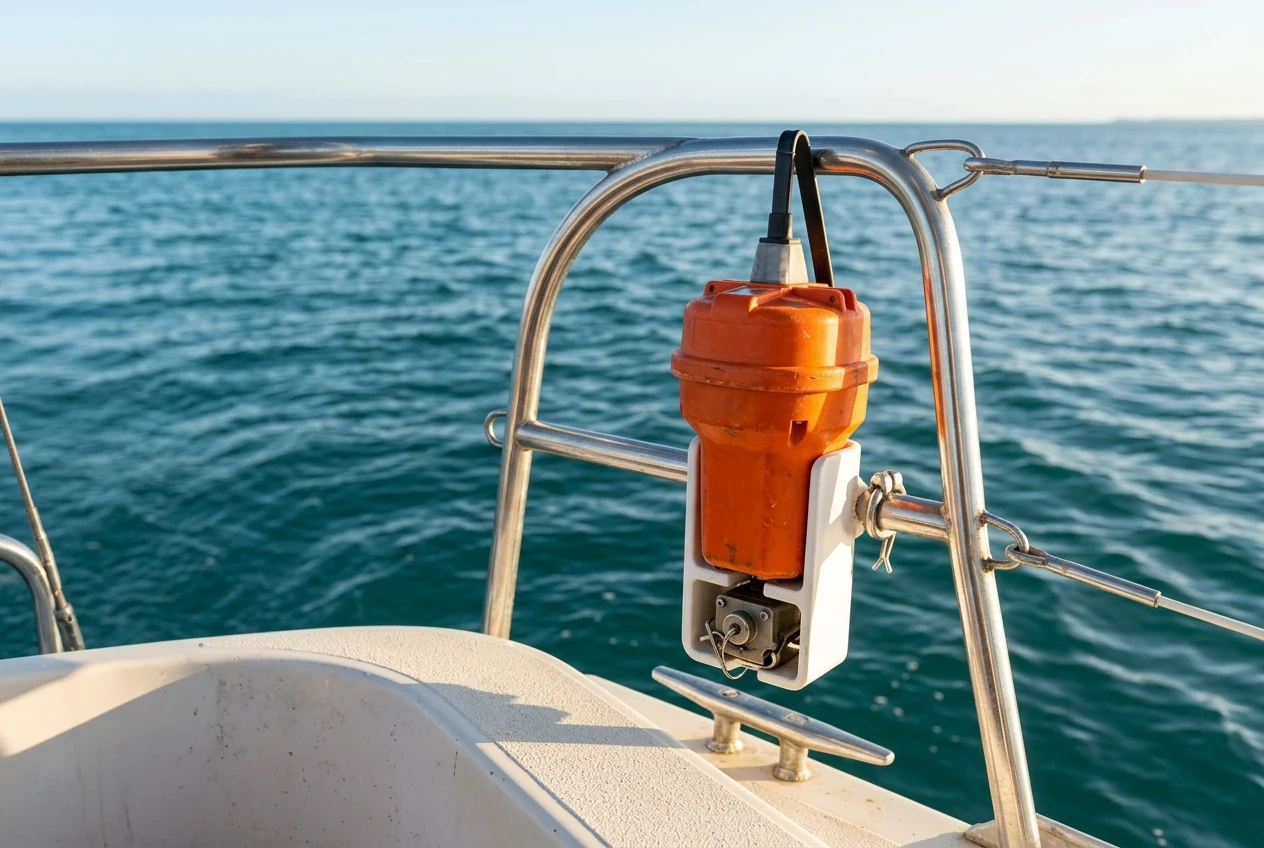
EPIRB: bracket, release and automatic activation
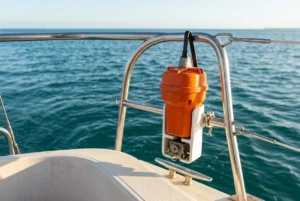
A Category I EPIRB sits in a bracket with a hydrostatic release unit. If the boat sinks, water pressure releases the beacon at a short distance below the surface. The beacon floats up, and a water-contact switch turns it on without anyone having to do anything. This matters when a boat goes down quickly, and the crew has no time to reach the unit.
The same beacon can also be pulled from its bracket and activated by hand. In a liferaft, the crew can tether the floating beacon to the raft or hold it in the water-contact position so it transmits properly.
Some EPIRBs are manual-only and are usually sold as Category II. They are cheaper and smaller, but they require someone to reach the unit and switch it on. Which category your boat needs, if any, depends on where you sail and the regulations that apply to your vessel. Rules differ between countries and vessel types, so check with your national maritime authority rather than relying on a general article, including this one.
Where you mount an EPIRB matters as much as which one you buy. It should be somewhere the crew can reach it quickly, and where the float-free release has a clear path to the surface. Mounted inside a locker, beneath the boom’s reach or under a cockpit structure, it can stay trapped by rigging, a bimini or the cabin top as the boat goes down. The hydrostatic release also has an expiry date and must be replaced on schedule.
PLB: on the body, switched on by hand
A PLB is typically a little larger than a deck of cards or a small phone. You carry it in a lifejacket pocket, clipped to the jacket, or on a harness. To use it, pull out the antenna if it has one, press the activation button or buttons, and keep the antenna pointing toward the sky as much as possible.
PLBs vary on whether they float. Some do and some sink, in which case they need a floating pouch. A beacon that floats upside down or sideways still transmits poorly, so check how your model behaves in water and read the manufacturer’s guidance on how to hold it. The person using it may be cold, wearing gloves, and bobbing in waves, so practice the activation sequence with the unit’s test function out of the water, and not for the first time in an emergency.
Some automatic lifejacket manufacturers offer a PLB pocket or an integrated beacon that activates when the jacket inflates. These are convenient, but confirm the details for your specific jacket-and-beacon combination before relying on them.
Coastal day sailing: is a PLB on your lifejacket enough?
For many coastal sailors, a PLB on a lifejacket is the sensible first purchase. The reasons are practical.
On a day sail, you are usually within VHF range of the coast guard, near other boats and close to shore. A VHF radio with DSC, a handheld VHF, a charged phone in a waterproof pouch, and a flare kit cover most issues that can arise in these conditions. A beacon is what you use when none of those have worked or been possible: you have lost the radio, you are in the water, or the boat is lost, and the crew is split up.
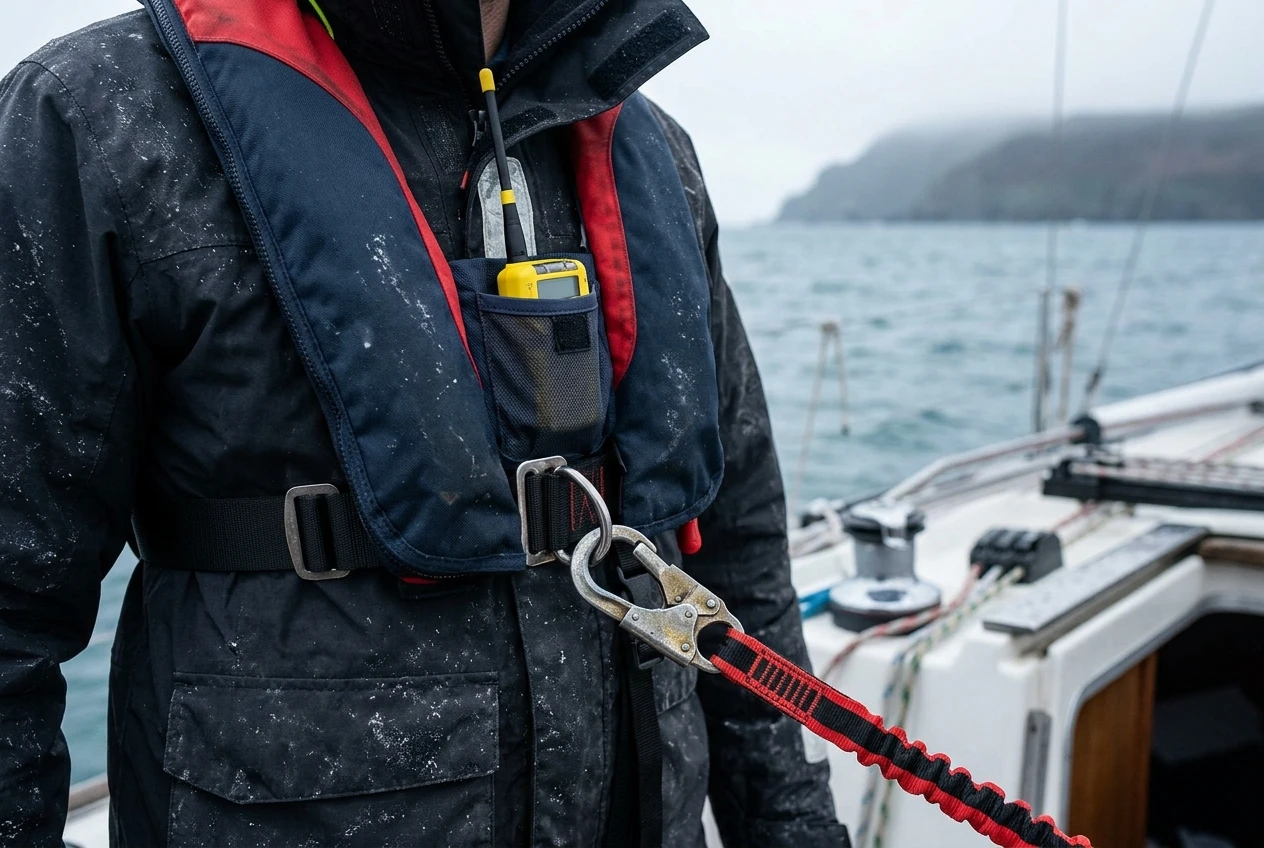
A PLB covers the most dangerous version of that. If you go over the side and the boat sails away, the beacon is on you, so you can still raise the alarm. Boat-mounted equipment is of no use to a person in the water.
An EPIRB on a coastal day boat is a reasonable addition, though it is not essential to the same degree. If your day sailing keeps you close to shore in a small boat, an EPIRB covers the boat being lost with everyone aboard, a situation in which a PLB on each lifejacket would also work. A small, open boat that capsizes may leave people in the water holding onto the hull, with the PLB on each person still transmitting.
For the coastal sailor, the questions that decide it are these:
- How far from shore and from help do you sail, and in what conditions?
- Do you sail alone or short-handed, so that nobody can turn the boat around if you fall off?
- Does each person aboard wear a lifejacket with a beacon, or only the skipper?
- Do regulations in your waters require an EPIRB at certain distances or for certain vessels?
If the answers include sailing alone or in cold water, the PLB moves from a good idea to something close to essential.
Offshore passages: why the boat needs an EPIRB
On an offshore passage, the main risk changes. Help is hours or days away, VHF is useless beyond roughly line of sight to other boats or a shore station, and the boat becomes the crew’s whole survival system. If it sinks or burns, the crew must get into a liferaft, and the EPIRB tells rescuers where to look.
Several features of the EPIRB suit this. It activates automatically if the boat sinks too quickly for anyone to reach it. The beacon is registered to the vessel, so when the rescue centre receives the alert it can look up the boat’s description, its owner and the emergency contacts. It has a longer minimum operating life than a PLB: the standards require EPIRBs to transmit for at least 48 hours, while PLBs must transmit for at least 24 hours. Many units exceed that, so check the rating for your model. A rescue far offshore can take a long time, and the extra hours are meaningful.
An EPIRB also stays with the boat and with the liferaft. A crew of four with one EPIRB in the grab bag or bracket has a single beacon pointing to one location, which is easier for searchers to work with than four separate signals drifting apart.
Offshore, then, the EPIRB is the first beacon to buy. A PLB alone leaves a gap in two ways. Nobody may be awake or able to switch it on when the boat sinks. And a single PLB on one person, if the crew has to abandon ship, signals only for that person, not for a liferaft with several people in it. Many offshore crews carry both, and the next section explains why.
Person overboard: where a personal beacon changes the outcome
An EPIRB on the boat does nothing for someone who is no longer on board. This is the clearest reason PLBs exist.
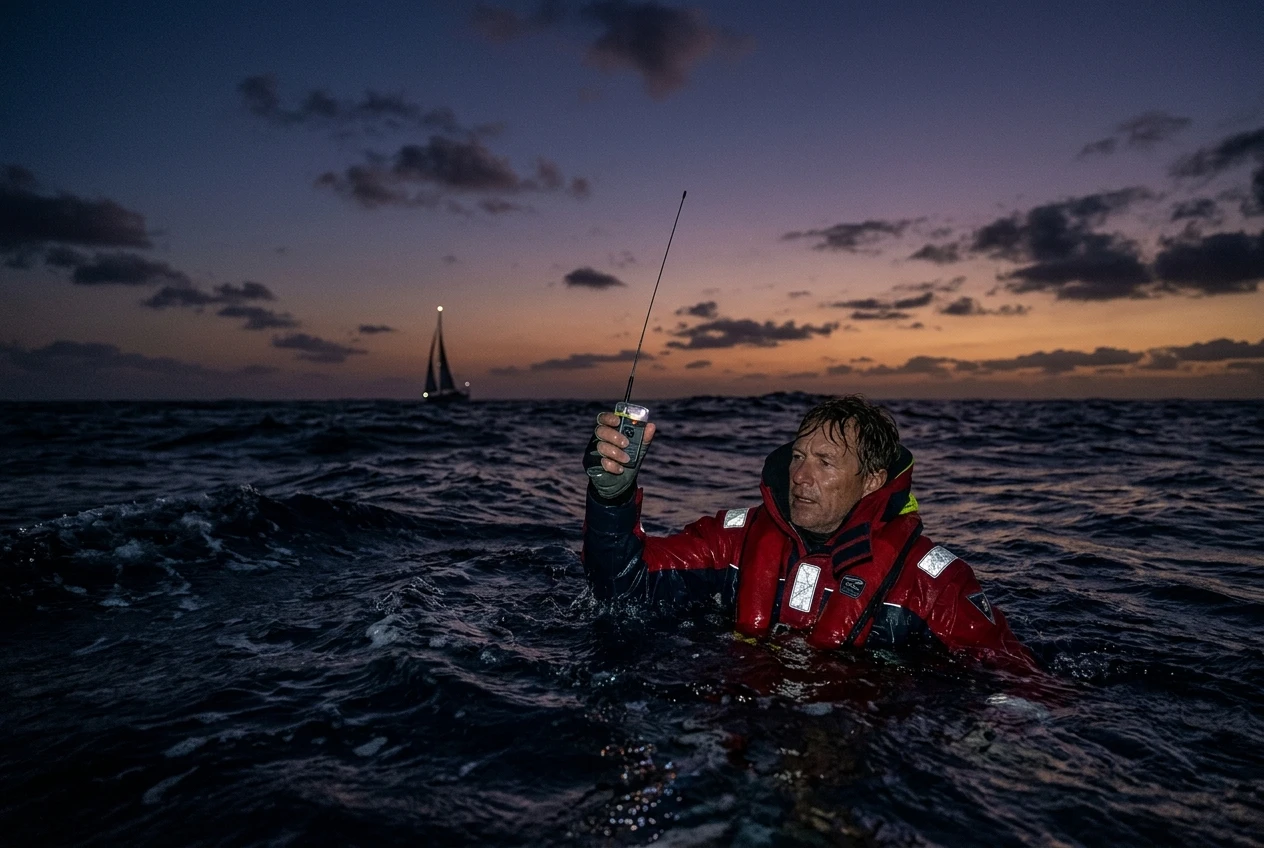
Think through the sequence. A sailor falls overboard at night. The boat keeps sailing on autopilot or self-steering, and the other crew are below, asleep or unaware. Or the sailor is alone. The boat, and its EPIRB, move away at several knots. The person in the water has a lifejacket, perhaps a whistle and a light, and, if they carry one, a PLB.
With a PLB, they can send a distress signal with their location, and the rescue center can send help to them. Without one, the first alert depends on someone noticing the person is missing, and the boat then has to navigate back to a spot that is moving as the person drifts.
Satellite beacons are not instant. The alert goes to a satellite, then to a ground station, then to a rescue coordination center, and finally to whoever can respond. For this reason, sailors often treat a PLB as the backup to crew action, not a replacement for it. If another crew member sees the person go over, the quickest rescue is almost always the boat itself. Marking the position, throwing flotation, and turning back come before any beacon.
Personal AIS beacons fill a different role. They transmit to AIS receivers on nearby vessels and sometimes to the boat’s own chartplotter, which can raise an alarm and show the bearing to the person. They work over a short range and rely on someone nearby receiving the signal, whereas a PLB reaches the satellite network from anywhere. Some crews carry an AIS personal beacon for the boat’s own recovery, and a PLB for outside rescue. If you want to understand how AIS works on a busy route, how AIS prevents collisions at sea explains the system these personal devices use.
The decisions that matter for overboard situations are the practical ones:
- Wear the beacon, not store it. A PLB in a locker will not help the person in the water.
- Attach it to the lifejacket or harness so it cannot come loose when you hit the water.
- Make sure every crew member who goes on deck at night knows how to switch it on.
- Think about water temperature. Cold water shortens the time a person can function, making the signal delay more serious.
Registration, battery life and servicing: the ownership details people skip
A beacon does its job only if it is registered, in date, and in working order. These details get less attention than the hardware, and they often decide whether an alert is useful.
Registration
Every 406 MHz beacon has a unique identification code. Registering it with the national authority links that code to you or your boat and includes emergency contacts. When the alert arrives, the rescue center can check who you are, what the vessel looks like and whom to call. It can also tell more quickly whether the alert is real or a false alarm, because a call to a contact might reveal that the beacon was knocked on accidentally.
An unregistered beacon still transmits, but the rescue center receives an anonymous signal, and the response can be slower. Registration requirements and procedures differ by country, and some countries require it by law, so look up your own authority’s process. The EPIRB is registered to the vessel. The PLB is registered to the person and travels with them, so check how your authority handles a PLB used on different boats or in different countries.
Registration also needs upkeep. Update the details if you change your phone number, sell the boat, change vessel name or flag, or pass the beacon to someone else. An out-of-date record sends rescuers to call a contact who cannot help.
Battery life and expiry
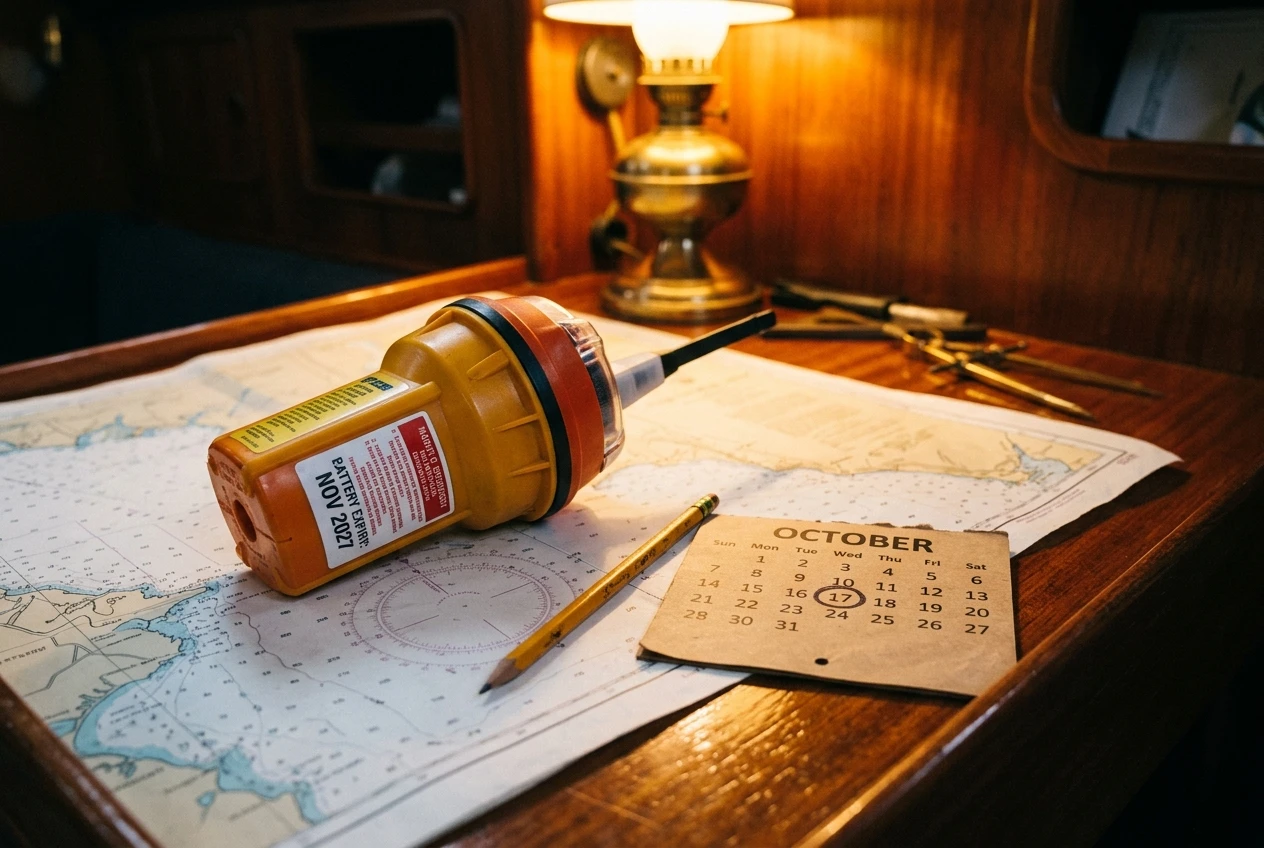
Beacon batteries have an expiry date printed on the unit, and a beacon with an expired battery is not reliable. The standards set minimum operating times (48 hours for EPIRBs, 24 for PLBs), and these apply only to a battery in date, in a unit that has been looked after.
Check the dates when you buy. Beacons sit in stock, and the clock on the battery may already be running. Put the expiry on your calendar, and add the hydrostatic release expiry as well, since it is a separate item with its own replacement date.
Servicing and testing
Most beacons have a self-test function that checks the circuitry and battery without sending a distress signal. Follow the manufacturer’s instructions on how often to use it, because testing too often uses up battery. Never test by activating the beacon for real. A false alert sends rescuers to look for you and can lead to penalties.
Battery replacement is often a job for the manufacturer or an approved service center, because the unit is sealed to keep water out. Check your model’s manual before opening anything, and have the replacement done before the date, not after.
Choosing for your boat: a simple decision guide by sailing type
Work from where you sail and how many people are aboard.
- Day sailing close to shore, with a crew: a PLB on each lifejacket, or at least on the person most likely to be alone on deck. An EPIRB is optional unless your local rules require one.
- Day sailing alone or in cold water: a PLB worn on the body is the priority. A person alone has nobody to turn the boat around.
- Coastal cruising with overnight passages: an EPIRB for the boat, plus a PLB for anyone who stands night watches alone.
- Offshore passages: an EPIRB, with a float-free bracket if the boat’s category allows it, mounted so it clears the rigging. Add a PLB for each crew member who goes on deck, worn in the lifejacket.
- Small open boat or dinghy sailing: a PLB in a lifejacket pocket, because there is usually nowhere to mount an EPIRB and no time to reach one.
- Delivery skippers and crew who sail on other people’s boats: a personally owned PLB goes with you from boat to boat, so you are covered regardless of what the boat carries.
For anyone sailing offshore, the answer is usually both: the EPIRB for the boat and a PLB on each person. They signal for different emergencies. The cost of a PLB is small compared to the rest of an offshore safety kit, and for the person in the water, it can be the only equipment that works.
Before you buy, check three things beyond type. Confirm the beacon has built-in GPS. Confirm it is approved and can be registered in the country where you will register it. Confirm your lifejacket has a place to carry a PLB, or buy a pouch that fits.
Where beacons fit alongside your other safety gear
A beacon is the last resort in a chain of safety equipment, and most emergencies should be resolved before anyone presses it. Lifejackets, harnesses and tethers keep people on the boat. A VHF radio with DSC lets you call for help directly and reach nearby vessels. Flares, a liferaft, and a grab bag address abandoning ship. A beacon works when everything else has failed, and nobody nearby can hear you.
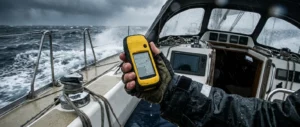
It also pays to keep position information independent of the boat’s main electronics. If the boat loses power, a battery-powered handheld lets you read your coordinates for a radio call and track your own drift. The article on handheld GPS for sailing covers what to look for in such a unit.
Think of a beacon as part of a plan that includes passage planning, a float plan left with someone ashore, and regular drills so every crew member knows where the equipment is and how to use it. A beacon locked in a bag or never registered helps nobody, and a well-placed one the crew knows how to operate might be what gets them found.
Check your own boat against the full list in The Safety Equipment Every Boat Needs Before It Leaves the Dock, then decide which beacon is still missing.
This article was created with AI assistance and reviewed by a human editor.
Disclosure: This post contains Amazon affiliate links. If you buy through them, we may earn a small commission at no extra cost to you.
About The Author