Disclosure: This post contains affiliate links. As an Amazon Associate, I earn from qualifying purchases at no extra cost to you.
The best LiDAR robot lawn mower for most homeowners in 2026 is the Dreame A3 AWD Pro 2500, with the Ecovacs Goat A2000 LiDAR PRO as the value pick and the Mammotion Luba Mini 2 AWD for small, cluttered yards. All three sit near the top of Amazon’s Best Sellers list in Robotic Lawn Mowers, and that tells you something important: LiDAR has moved from a niche experiment to the mainstream choice.
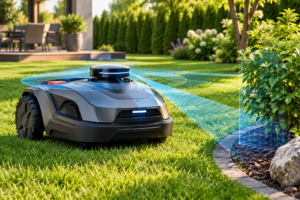
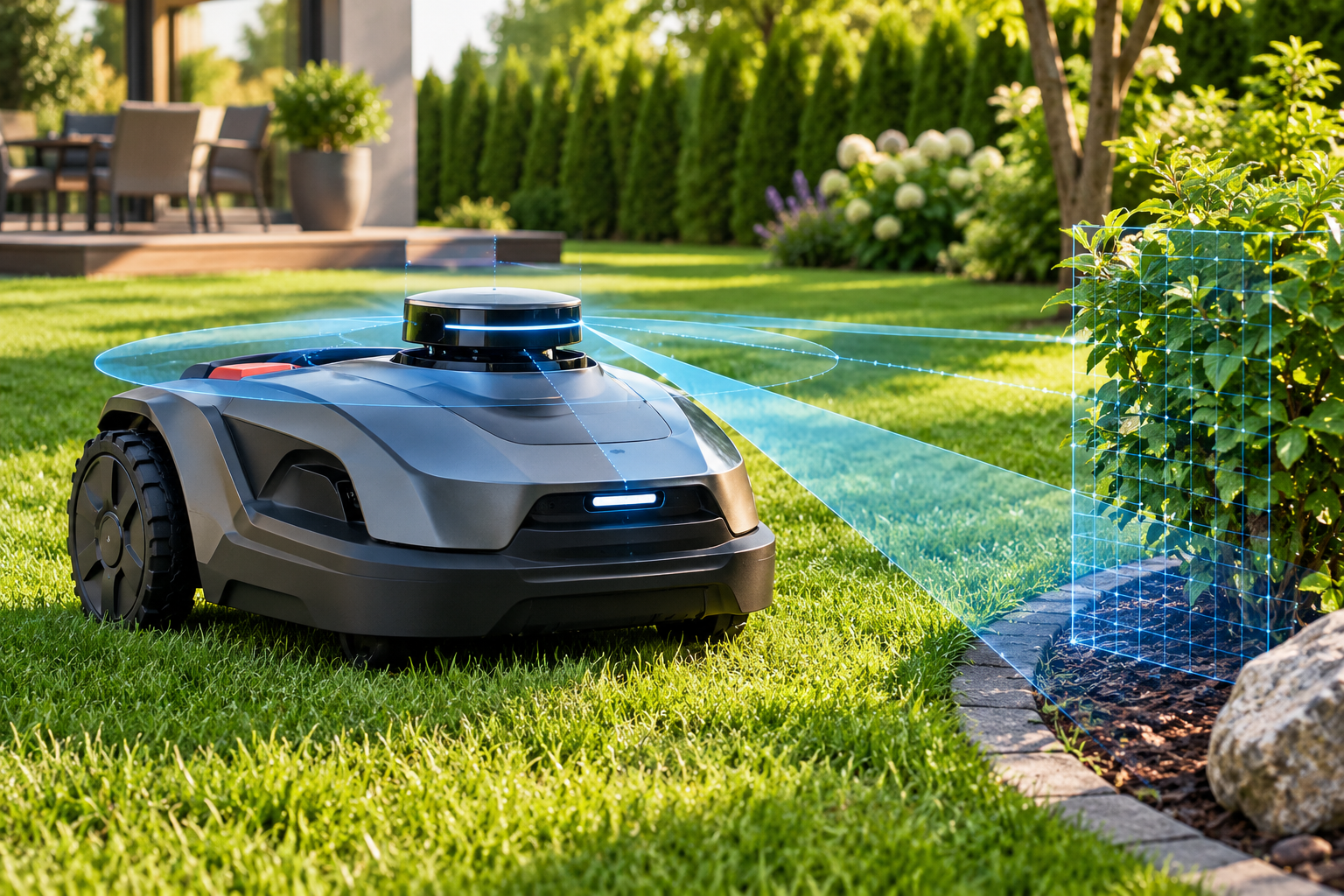
Only a few years ago, every robot mower needed a perimeter wire buried around the lawn. Then came RTK GPS mowers, which ditched the wire but needed a rooftop antenna and a clear view of the sky. LiDAR mowers skip both. They scan the yard with a spinning laser, build a 3D map, and know exactly where they are, even under trees and next to tall houses.
In this guide, we break down the LiDAR models that are actually selling on Amazon right now, explain what each one does well and where it falls short, and help you match a mower to your lawn size, slope, and budget.
Quick picks:
- Best overall: Dreame A3 AWD Pro 2500 — 0.62-acre coverage, AWD, 80% slopes
- Best value: Ecovacs Goat A2000 LiDAR PRO — dual LiDAR, built-in edge trimmer, up to 1/2 acre
- Best for small, complex yards: Mammotion Luba Mini 2 AWD — compact, nimble, LiDAR plus dual cameras
- Best for flat lawns and night mowing: Segway Navimow i215 LiDAR — quiet, simple, 0.37 acre
- Best for connected security: Roborock RockMow X120H LiDAR — 4G tracking, AWD
- Best premium alternative: Mova LiDAX Ultra 3000 AWD — 0.75 acre, flagship build
What Is a LiDAR Robot Lawn Mower?
A LiDAR robot lawn mower uses a laser scanner to measure distances to everything around it and build a live 3D map of your yard. LiDAR stands for Light Detection and Ranging. The sensor fires thousands of laser pulses per second and measures how long each one takes to return. The result is a dense “point cloud” of trees, fences, walls, flower beds, and the house itself.
The mower then uses that map in two ways. First, it localizes itself: by matching what it sees now against the stored map, it knows its position to within a few centimeters. Second, it plans clean, straight stripes and avoids obstacles in real time.
Most 2026 LiDAR mowers pair the laser with one or two AI cameras. The LiDAR handles geometry and positioning, while the cameras recognize what an object actually is — a garden hose, a toy, a hedgehog, or a pet. That combination is why brands now advertise recognition of 200+ obstacle types.
Why LiDAR beats the old ways
- No perimeter wire. You don’t spend a weekend burying cable, and you never hunt for a wire break with a fault finder again.
- No RTK antenna. RTK GPS mowers need a reference station with a clear view of the sky. LiDAR works under trees, beside tall buildings, and in narrow side yards where satellite signals drop out.
- Works in the dark. A laser doesn’t need daylight, so many LiDAR models can mow at night when the lawn is free of kids and pets.
- Faster setup. Several models map the yard automatically. You drive the boundary once in the app, or let the mower find the edges itself, and you’re mowing within an hour.
The trade-offs
LiDAR is not perfect. Very large, open lawns with few landmarks give the sensor less to lock onto, which is why some brands still offer RTK as a backup. Spinning mechanical LiDAR units can collect dust and need an occasional wipe, while newer solid-state sensors (like Segway’s) have no moving parts. And LiDAR models still cost more than basic wired mowers.
LiDAR Robot Mower Comparison Table (2026)
All six models below are wire-free, need no RTK antenna to run, and appear on Amazon’s Robotic Lawn Mower bestseller or new-release lists as of autumn 2026.
| Model | Best for | Max lawn size | Max slope | Navigation | Drive | Typical Amazon price |
|---|---|---|---|---|---|---|
| Dreame A3 AWD Pro 2500 | Best overall, hills | 0.62 acre | 80% (38.7°) | 360° 3D LiDAR + dual AI vision | AWD | Check live price |
| Ecovacs Goat A2000 LiDAR PRO | Best value, edges | 0.5 acre | 45–50% | Dual LiDAR (360° + 3D ToF) + AI vision | 2WD | $1,399–$1,999 |
| Mammotion Luba Mini 2 AWD | Small, complex yards | 0.37 acre | 80% | 360° LiDAR + dual-camera vision | AWD | Check live price |
| Segway Navimow i215 LiDAR | Flat lawns, night mowing | 0.37 acre | 45% | Solid-state LiDAR + 140° camera | 2WD | about $1,599 |
| Roborock RockMow X120H LiDAR | Security, rough terrain | 0.49 acre | 80% (38.7°) | 360° 3D LiDAR + dual-camera vision | AWD | $2,499–$3,199 |
| Mova LiDAX Ultra 3000 AWD | Premium, larger lawns | 0.75 acre | 80% (38.6°) | 3D LiDAR + AI vision | AWD | Check live price |
Prices on Amazon move weekly, especially around Prime Day and Black Friday, so treat these as a guide and check the current listing.
Best LiDAR Robot Lawn Mowers on Amazon: Detailed Reviews
1. Dreame A3 AWD Pro 2500 — Best Overall LiDAR Mower
The Dreame A3 AWD Pro 2500 is the LiDAR mower to beat in 2026. It ranks in the top five of Amazon’s Robotic Lawn Mower bestsellers and was named the best mower for steep slopes in Bob Vila’s 2026 hands-on test, where it handled thick St. Augustine grass and hills that made rival mowers slip or reroute.
The headline spec is a 360° 3D LiDAR sensor paired with dual AI cameras, so there’s no wire and no antenna. Four-wheel drive lets it climb slopes up to 80% (38.7°), and it covers up to 0.62 acre. Edge trimming gets to within roughly an inch of borders, which cuts down on string-trimmer work.
Pros: best-in-class slope handling; quick, accurate mapping; polished app; strong cut quality in dense grass.
Cons: premium price; heavier than compact models; Dreame is a newer name in lawn care, so long-term reliability data is limited.
Who it’s for: owners of 1/4- to 2/3-acre lawns with hills, terraces, or awkward transitions between zones. If you want a larger lawn version, Dreame also sells Pro 3500 and Pro 5000 variants on Amazon.
2. Ecovacs Goat A2000 LiDAR PRO — Best Value
The Ecovacs Goat A2000 LiDAR PRO is one of the most popular LiDAR mowers on Amazon, and price is a big reason why. It regularly sells for about $1,399 to $1,999 — well below most AWD flagships.
Ecovacs uses two LiDAR sensors: a 360° rotating unit for mapping and a 3D time-of-flight sensor for close-range obstacles. Its AIVI 3D vision recognizes over 200 common garden objects. The standout feature is the built-in TruEdge trimmer, a spinning string head that trims right up to fence lines and beds, something most rivals sell as an add-on or skip entirely.
It covers up to half an acre, offers a 13-inch cutting width (wider than most competitors), a runtime of around 150 minutes, IPX6 water resistance, and works with Alexa, Google Home, and Home Assistant.
Pros: excellent price for the tech; integrated edge trimmer; wide cutting deck; long runtime; smart-home support.
Cons: two-wheel drive, so slope limit is lower (roughly 45–50%) than AWD rivals; not the best choice for very hilly yards.
Who it’s for: flat to gently sloping suburban lawns up to half an acre where tidy edges matter.
3. Mammotion Luba Mini 2 AWD — Best for Small, Complex Yards
Mammotion built its reputation on AWD robot mowers, and the Luba Mini 2 AWD brings that know-how into a compact chassis. Amazon lists it as a 2026 release with 360° LiDAR plus dual-camera AI vision, an 80% slope rating, and coverage of up to 0.37 acres.
In Bob Vila’s test, it won “best for complex yards” because its small size let it weave through tight passages and around obstacles that bigger mowers struggled with. All-wheel drive kept it planted on steep ground.
Pros: very nimble; strong AWD traction; refined app; trusted brand in robot mowing.
Cons: smaller coverage area for the price; not ideal for lawns much over a third of an acre.
Who it’s for: front yards, side yards, and gardens full of trees, beds, and play equipment.
4. Segway Navimow i215 LiDAR — Best for Flat Lawns and Night Mowing
Segway’s Navimow line has been one of Amazon’s best-selling robot mower brands for years, and the i215 LiDAR is its first model to drop the RTK antenna entirely. It retails around $1,599, according to PCWorld’s review.
Instead of a spinning laser, it uses a solid-state LiDAR with no moving parts, fused with a 140° camera. That makes it more durable and lets it mow at night. It handles lawns up to 0.37 acres and slopes up to 45%, runs up to 160 minutes per charge, and is notably quiet at 59 dB(A).
Pros: easy automatic mapping; durable solid-state sensor; quiet; long runtime; Alexa and Google Home support.
Cons: two-wheel drive limits performance on slopes; the Navimow Connect+ cellular service requires a paid renewal after year one.
Who it’s for: flatter lawns with trees or walls that would block RTK GPS signals.
5. Roborock RockMow X120H LiDAR — Best for Security and Rough Terrain
Roborock is famous for its robot vacuums, and the RockMow X120H is its first major push into lawn care. It launched on Amazon at $2,499 with a $3,199 list price, and it hit #1 on Amazon’s new-release chart for robotic mowers.
It combines 360° 3D LiDAR with dual-camera AI vision, AWD with active steering, an 80% (38.7°) slope rating, and the ability to climb over 3.1-inch obstacles. The big differentiator is built-in 4G cellular with three years included, so you can track the mower from anywhere if it’s moved or stolen. It also has a rain sensor and returns to its dock automatically when it starts to rain.
Pros: excellent terrain handling; built-in 4G anti-theft tracking; rain sensing; floating cutting deck for even cuts.
Cons: expensive; edge cutting needs an optional module; no Alexa or Google Home integration at launch.
Who it’s for: larger, uneven, or exposed front-yard lawns where theft is a real worry.
6. Mova LiDAX Ultra 3000 AWD — Best Premium Alternative
Mova shares a parent company with Dreame, and the LiDAX Ultra 3000 AWD is very similar to the Dreame A3 AWD Pro. Bob Vila’s tester noted that the hardware, software, and app are nearly identical. The Mova version extends coverage to 0.75 acres while maintaining the same 80% slope rating, LiDAR plus AI vision, and a premium build.
Pros: largest coverage in this list; flagship-level navigation and cut quality; polished design.
Cons: high price; little reason to choose it over the Dreame unless you need the extra coverage or find a better deal.
Who it’s for: buyers with lawns between 0.6 and 0.75 acres who want a top-tier LiDAR mower. Mova’s cheaper LiDAX Ultra 2000 covers half an acre.
LiDAR Lawn Mower Buying Guide: What to Look For
Pick a LiDAR mower by matching four things to your lawn: area, slope, layout, and budget. Everything else is a nice-to-have.
1. Lawn size (with a safety margin)
Manufacturers quote maximum coverage under ideal conditions. Choose a model rated at least 20–30% above your actual mowable area. A 0.3-acre lawn is a better match for a 0.37–0.5-acre mower than for one rated at exactly 0.3 acres, because real lawns have obstacles, multiple zones, and faster growth in spring.
2. Slope and drive type
This is the spec that most often separates a happy owner from a frustrated one. Two-wheel-drive models like the Ecovacs Goat A2000 and Segway i215 handle up to roughly 45–50%. If any part of your yard is steeper, go for an AWD model rated at 80%, such as the Dreame A3 AWD Pro, Mammotion Luba Mini 2 AWD, or Roborock X120H. Remember that slope ratings assume dry grass; wet slopes are harder.
3. Yard layout and obstacles
Lots of trees, beds, play sets, and narrow passages favor compact, nimble mowers with strong camera-based obstacle recognition. Check the minimum passage width the mower can handle — around 80 cm is common. If you have several separate lawn areas, make sure the app supports multi-zone maps and channels between them.
4. Edge trimming
Robot mowers traditionally leave a strip of uncut grass along walls and borders. The Ecovacs Goat’s built-in TruEdge trimmer is the strongest answer here. Others offer near-edge cutting to about an inch, or optional edge modules at extra cost.
5. Connectivity and theft protection
Wi-Fi and Bluetooth are standard. Built-in 4G (Roborock, Mova, some Mammotion models) lets you track the mower if it leaves your property and control it when Wi-Fi doesn’t reach. Check whether cellular service is free for a period or needs a subscription. PIN locks and alarms are also worth having for front-yard lawns.
6. Smart-home support
If you use Alexa, Google Home, or Home Assistant, check compatibility before you buy. Ecovacs and Segway are currently the strongest here.
7. Weather protection and maintenance
Look for at least IPX6 so you can hose the mower down. A rain sensor that sends it back to the dock protects the lawn and the machine. Budget for replacement blades every 1 to 2 months during the mowing season.
LiDAR vs RTK vs Vision vs Perimeter Wire
LiDAR is the best all-round choice for typical suburban yards with trees and buildings; RTK still wins on huge, open lawns. Here’s how the four navigation types compare:
| Navigation type | Setup | Works under trees / near buildings | Works at night | Best for |
|---|---|---|---|---|
| LiDAR (+ vision) | Easy, often automatic mapping | Yes | Yes | Most yards, especially with trees, walls, and obstacles |
| RTK GPS | Moderate: mount a reference antenna with open sky | Weak in shade and “urban canyons” | Yes | Large, open lawns of 1 acre and up |
| Camera vision only | Easy | Yes | No, needs daylight | Small, simple, well-lit lawns on a budget |
| Perimeter wire | Hard: bury or peg cable around the whole lawn | Yes | Yes | Cheapest option; owners who don’t mind installation |
Many 2026 models blur these lines. The Segway Navimow X430 uses RTK with cameras, while some Mammotion models combine LiDAR, RTK, and vision. If your yard mixes open lawn with shaded areas, a hybrid can make sense — but for most buyers, a LiDAR-plus-vision mower is the simplest path to a wire-free, antenna-free setup.
Frequently Asked Questions
What is the best LiDAR robot lawn mower on Amazon?
For most people, the Dreame A3 AWD Pro 2500 is the best LiDAR robot lawn mower on Amazon thanks to its AWD, 80% slope rating, and 0.62-acre coverage. If you want to spend less, the Ecovacs Goat A2000 LiDAR PRO offers dual LiDAR and a built-in edge trimmer at a lower price.
Do LiDAR lawn mowers need a perimeter wire?
No. LiDAR mowers map your yard with a laser scanner and cameras, so you set boundaries in the app instead of burying cable.
Do LiDAR robot mowers need an RTK antenna?
No. That’s the main advantage over RTK GPS mowers. A LiDAR mower positions itself by recognizing its surroundings, so it can operate under trees and near buildings where satellite signals are weak.
Can a LiDAR mower work at night?
Yes. LiDAR doesn’t rely on daylight, so models like the Segway Navimow i215 LiDAR can mow after dark. Check local noise rules and keep pets indoors.
How steep a slope can a LiDAR mower handle?
It depends on the drive system. Two-wheel-drive models handle around 45–50%, while AWD models like the Dreame A3 AWD Pro, Mammotion Luba Mini 2 AWD, and Roborock X120H are rated up to 80% (about 38–39°).
Are LiDAR robot mowers safe around kids and pets?
They include AI obstacle recognition, lift and tilt sensors that stop the blades, and emergency stop buttons. Even so, the safest practice is to schedule mowing when children and pets are not on the lawn.
How long do robot lawn mowers last?
With regular cleaning and blade changes, most robot mowers last 5 to 10 years. The battery is usually the first part to need replacing.
Is a LiDAR mower worth the money?
If your yard has trees, buildings, or complex shapes that interfere with RTK, and you don’t want to install a wire, then yes. You save hours of mowing every week and get a consistently even lawn, because frequent small cuts are healthier for grass than one big weekly cut.
Final Verdict: Which LiDAR Mower Should You Buy?
The Dreame A3 AWD Pro 2500 is the best LiDAR robot lawn mower for most buyers in 2026: it maps fast, climbs 80% slopes, and cuts cleanly through thick grass. Choose the Ecovacs Goat A2000 LiDAR PRO if you want the most features per dollar and perfectly trimmed edges on a flatter lawn.
For small, cluttered yards, the Mammotion Luba Mini 2 AWD is the most agile option. The Segway Navimow i215 LiDAR suits flat lawns under trees where RTK fails. The Roborock RockMow X120H makes sense when theft protection and rough terrain matter most, and the Mova LiDAX Ultra 3000 AWD is the pick for larger lawns up to three-quarters of an acre.
Whichever you choose, measure your mowable area, check your steepest slope, and buy a model with headroom on both. Do that, and a LiDAR mower can take the weekly mowing off your list for good.
Affiliate disclosure: This article contains affiliate links. If you buy through them, we may earn a commission at no extra cost to you. Prices and Amazon rankings change often; check the current listing before buying.
Disclosure: This post contains affiliate links. As an Amazon Associate, I earn from qualifying purchases at no extra cost to you.
This article was created with AI assistance and reviewed by a human editor.
About The Author