
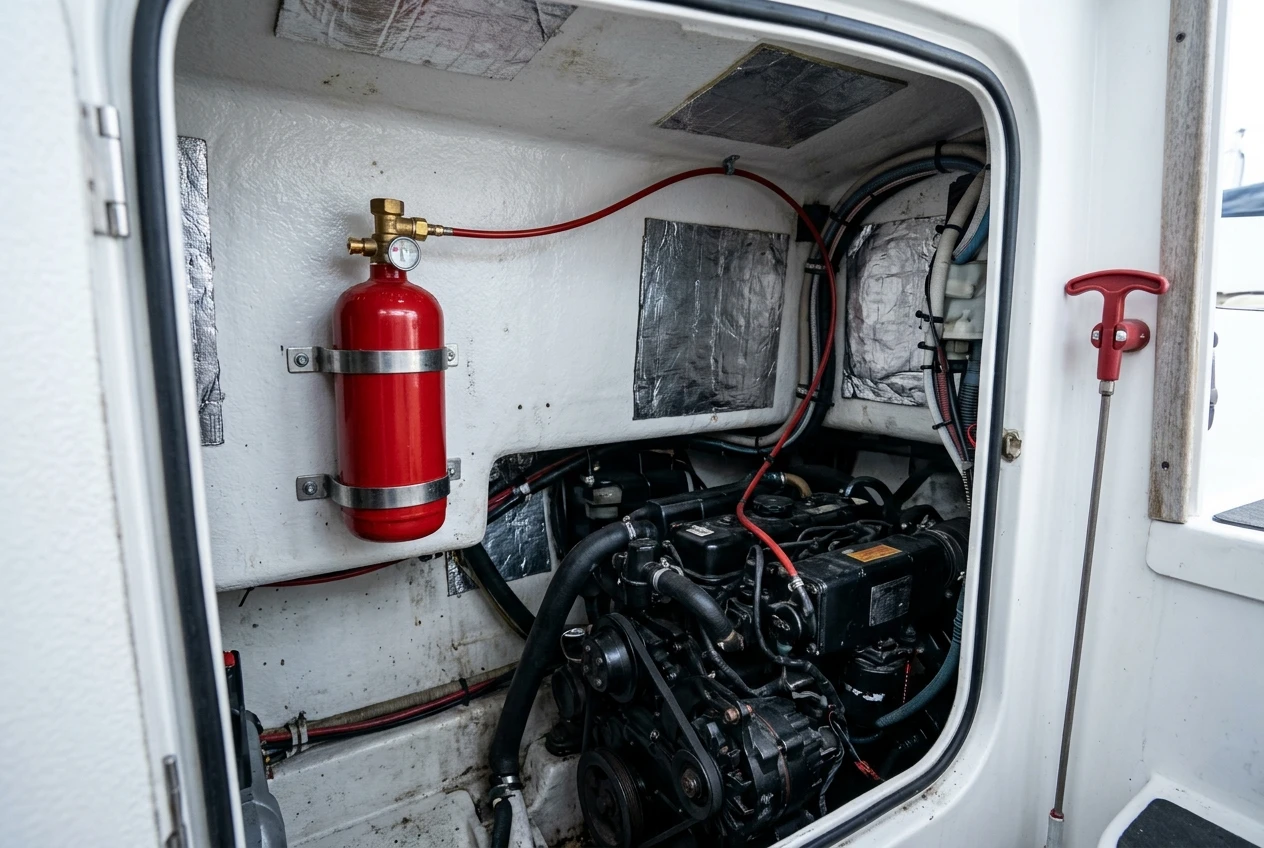
Fire is one of the few emergencies on a cruising boat that can go from a smell to an abandon-ship decision in minutes. Fire protection on an offshore boat is therefore a set of separate decisions for separate spaces, not a single extinguisher bought for the whole hull. The engine compartment is the space where an automatic fire suppression system for a sailboat engine compartment earns its cost, because a fire there starts out of sight and behind a closed hatch. Everywhere else, a hand-held unit or a blanket within arm’s reach does the job better.
This walkthrough goes through a fiberglass cruising boat space by space, says which ones justify automatic protection, and ends with the point where the fire plan stops and the abandon-ship plan starts.
Why a fire offshore is a different problem from a fire in a marina
At a dock, a fire is someone else’s problem as well as yours. Neighbors bring extinguishers, a hose is a few steps away, and the fire service arrives. You can step onto the pontoon and be safe.
Offshore, none of that applies. The crew is small, often two people, and one of them may be asleep. Help is hours or days away, and the sea around the boat cannot be stepped onto. Wind at sea fans a fire, and a boat sailing downwind carries the flames with it, so the first action is often to turn the boat so the fire isn’t driven toward the crew.
The boat itself is also fuel. Polyester resin laminate can burn once a fire is established, and foam, cushions, headliners, and wire insulation give off dense, toxic smoke. Smoke in a small cabin disables people before the flames reach them. That limits how long you can work on a fire below decks, and it’s why you need to decide early what you will fight and what you will leave.
Mapping the boat: where fires start
Different spaces burn for different reasons, and the cause decides the right response. Walk the boat in this order.
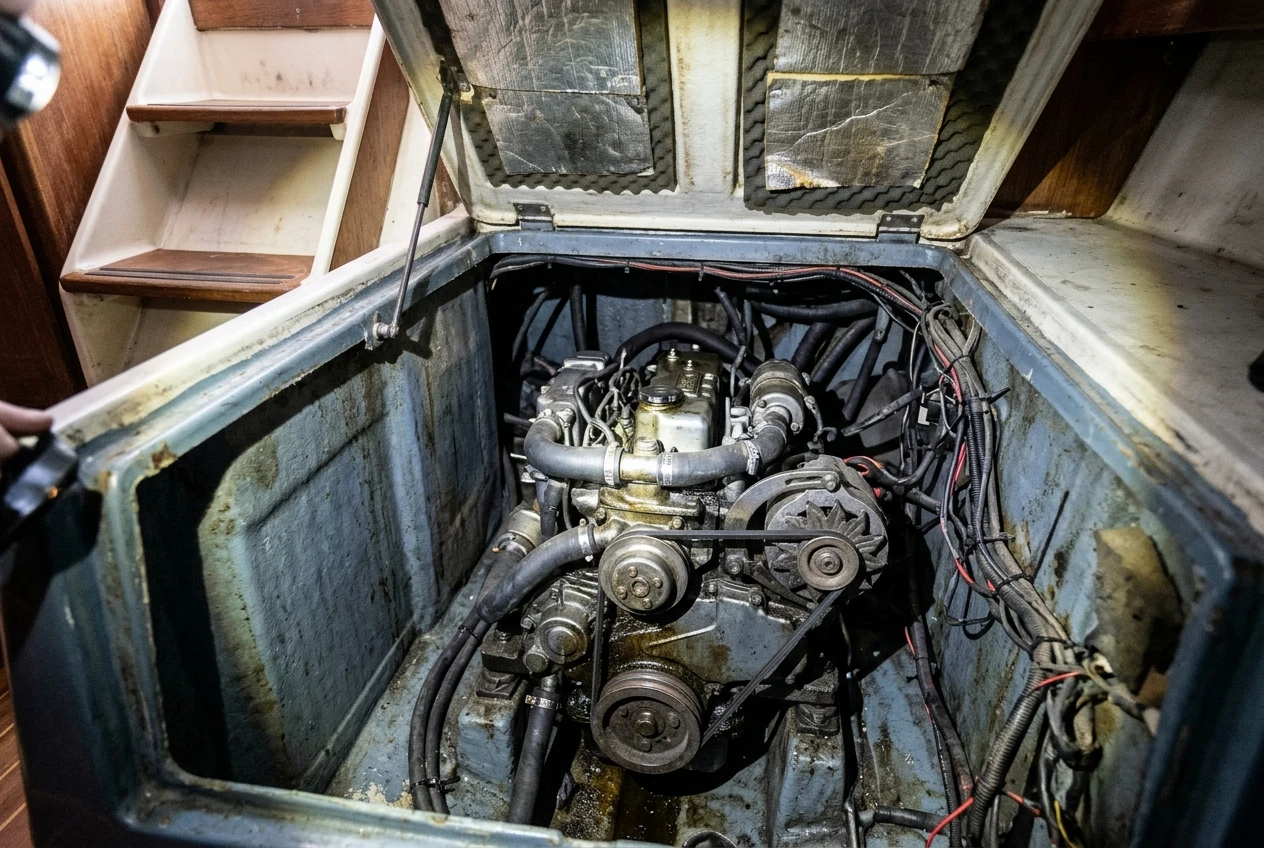
Engine compartment. Diesel, lubricating oil, hot exhaust components, an alternator, belts, and a lot of wiring share one enclosed space. A fuel or oil leak onto a hot surface, or an overheating cable, can start a fire that nobody sees. The space is usually closed, often under the companionway steps, and hard to reach quickly.
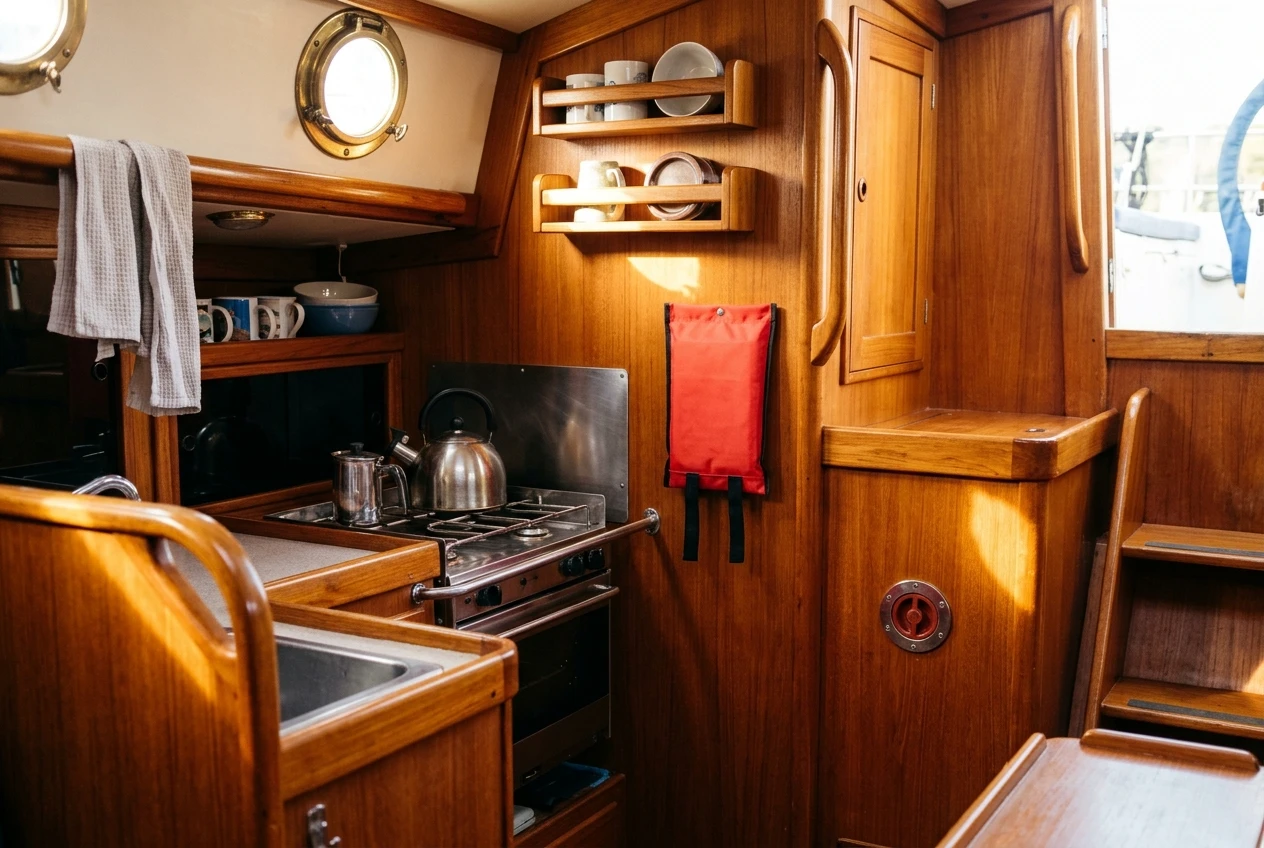
Galley. Cooking is the only place on the boat where open flame is used on purpose. Pan fires, a flare-up from a stove burner, or a gas leak from a fitting or hose are the main risks. People are normally present when it happens, which helps.
Electrical panel and battery areas. Overloaded or undersized cables, loose or corroded connections, chargers, inverters, and battery terminals are the usual sources. Batteries sit close to a lot of combustible material on many boats. A lithium house bank adds a different problem: a damaged or overheated cell can keep burning or reignite after the flames appear to be out. Follow the battery maker’s guidance for that equipment, and plan to cool it with water in volume while using an extinguisher on nearby burning material.
Cabins. Bedding, cushions, clothing, and linings burn readily. Typical sources are phone and laptop chargers left under pillows, lamps, candles, and anything smoking. A fire here is usually noticed by smell or smoke, so a smoke alarm in each sleeping area matters more than extra extinguishers.
Lockers. The risky ones are the ones that hold fuel or fumes: a locker with a spare fuel can, an outboard and its petrol, solvents, paint, a propane bottle locker, or a bilge where fuel vapor collects. Petrol vapor is heavier than air and sinks into the bilge. A propane locker should drain overboard so leaked gas leaves the boat.
Automatic suppression: what it does well in a closed engine space
An automatic system suits the engine compartment because of how a fire behaves there. The space is small, enclosed, unmanned, and usually closed while the engine runs. A fixed system mounted inside releases its agent into the whole volume, including the corners behind the engine that no hand-held nozzle can reach. It works when you are asleep, on deck, or at the helm with the companionway shut. A hand-held extinguisher cannot do any of that.
Most systems release when a heat-sensitive element reaches a set temperature, and many also have a manual pull. They are generally filled with a clean agent or CO2, which leaves little or no residue on the engine and electrics. The details differ by product, so read the manual for yours.
The system does not do the whole job, though, and the rest falls to you:
- Shut the engine down. A running engine keeps feeding the fire with fuel and air, and an engine blower or air intake can pull the agent out of the space. Some systems shut the engine down automatically or can be wired to do so. Others do not. Find out which yours is.
- Stop the ventilation. The agent only works if it stays in the compartment. Blowers should stop, and air intakes and louvers should close, as the manufacturer specifies.
- Keep the compartment shut. Opening the hatch to look lets in air and lets the agent out. Most manufacturers set a waiting period before you open. Know yours, and check the space for heat before opening.
- Check the sensing element. The element has to be rated for the highest temperature the space reaches. In the tropics, an engine compartment in a hot climate can run much hotter than in a cold one, and a poorly matched element can discharge when nothing is burning.
- Service it. Fixed systems have inspection and service intervals, pressure or weight checks, and a cylinder expiry date. A system with a missed service date may not work when it matters.
- Think about people. With CO2 in particular, anyone in a connecting space such as an aft cabin must be kept clear, because the gas can leak through gaps and is dangerous to breathe.
A fixed system is a good fit for any other enclosed space with a mechanical heat source and no one in it. A separate generator compartment or a fuel-tank space close to the engine can justify the same protection. The test is simple: if a fire could grow there with the hatch closed and nobody watching, automatic protection is worth considering.
The galley, cabins, and electrical panel fail that test. People are usually present, the fire is visible, and the fastest response is someone with the right tool in hand.
Manual extinguishers: matching agent type to each zone
No single extinguisher is right for the whole boat. A type that works well in one space does harm in another, and buying one type for everywhere is a compromise that suits no space particularly well.
- ABC dry powder. It puts out a wide range of fires and is cheap. The powder is corrosive, reduces visibility to almost nothing in a small cabin, is unpleasant to breathe, and can damage engines and electronics. It is a reasonable choice for a deck-accessible location or as a backup, and a poor first choice in a closed cabin.
- Clean agent (halocarbon type). It leaves little residue and suits fuel and electrical fires. Check the rating for the fire classes it covers, and note that the capacity per unit is often smaller than a powder extinguisher of the same size, so you may need a larger or second unit.
- CO2. It leaves no residue and handles fuel and electrical fires, but it does little to cool a fire and can allow reignition. In a small cabin, it displaces air, so using it below decks puts the user at risk too.
- Foam or water-based. It works well on fires in bedding, cushions, and other ordinary materials, making it a strong choice for cabins, where the fire is usually in soft furnishings. It is not suitable for live electrics or burning oil or fuel unless the label says it is.
A sensible mix for a cruising boat might be a clean agent unit near the engine compartment access, a water-based or foam unit in the sleeping cabins, a small unit in the galley area, and a fire blanket by the stove. The right set depends on your boat’s layout, size, and equipment, and on the rules your flag state, class society, or insurer applies. Check those requirements and read the class ratings on the label.
Placement and access: reach it from where a fire starts and where you would escape
A good extinguisher in the wrong place is useless. Two rules cover most of the decisions:
- You must be able to reach it without crossing the fire. An extinguisher beside the stove is no use if the stove is on fire between you and it. Mount it near the exit on the side you would approach from, such as near the companionway for the galley and saloon, so you can reach it on the way out and can retreat after using it.
- Put one near each sleeping area and one near each exit. A forward cabin with a single hatch needs an extinguisher at the hatch. Someone waking to smoke needs to reach it before they reach the flames.
Secure every unit in a proper bracket that holds it under heel and in a knockdown, and keep it out of lockers where it can be buried under gear. Everyone aboard should be able to point to each one in the dark. The engine compartment is the exception to all of this: you should not need to enter it or open it, which leads to the next section.
The fire blanket, the fire port and other cheap additions
Several inexpensive items cover gaps that extinguishers leave.
- Fire blanket. It smothers a pan fire without spraying anything into a small galley. Mount it near the stove but not directly above it, and make sure you can pull it free with one hand.
- Fire port. A small hole, covered by a flap or cap, in the engine compartment lets you discharge a hand-held extinguisher into the space without opening the hatch. It complements a fixed system and is the best option if you have only manual protection there. Fit it to the manufacturer’s or an installer’s guidance, so you do not weaken the compartment’s insulation or the fire resistance of the surrounding structure.
- Smoke and heat alarms. Fit smoke alarms in the cabins and saloon, and a heat alarm in the galley and engine area where smoke or steam would cause false alarms. Test them regularly.
- Gas detector. A propane or LPG sensor near the bilge tells you about a leak before it finds an ignition source.
- Remote shutoffs. Fuel shutoff valves, battery isolators, and the gas solenoid should be reachable from outside the space they control, so cutting fuel, power, or gas doesn’t mean going into a burning compartment. Label them.
- Bucket on a lanyard. A deck bucket with a line is useful for cooling hot surfaces and for fires in soft furnishings, and it has a use for many other jobs aboard.
If you are fitting out and want a broader view of the gear that goes with this, the essential sailing safety equipment checklist covers what a boat needs before it leaves the dock.
When to stop fighting and abandon
Fighting a fire has limits, and the skipper should decide where they are before the passage, not during the emergency. Some signs that it has been reached:
- The fire is between you and the extinguishers or the exit, or has cut off one of your two ways out of the boat.
- The extinguisher is empty, and the fire is still burning.
- The fire has spread into the hull lining, the laminate, or the structure rather than a single item.
- Propane, petrol, or a lithium bank is involved and cannot be isolated.
- Smoke is so heavy that people below can no longer see or breathe.
At that point the priority is getting everyone off safely, and the boat is secondary. Make the call early. Time spent on a fire that cannot be put out is time taken from preparing to leave.
Tie the fire plan to your abandon-ship plan so that one flows into the other. Send a distress call on the VHF with DSC if you can do it quickly, and activate the EPIRB, which a crew member can do on the way out. The EPIRB vs PLB comparison explains what each beacon does and which one suits a sailboat. Take the ditch bag, and check that it holds what you need by using the sailboat ditch bag checklist.
The life raft and ditch bag must be reachable even if a fire starts in the most likely place. If the raft is stowed at the stern and the engine fire is below the cockpit, you may not be able to get to either. Think about where each item is relative to each fire location, and keep a second route. Launch the raft on the side away from the fire and fuel, keep it tethered until everyone is aboard, and then cut free and move clear of the burning hull, as the raft’s instructions describe.
A fire check to run before each passage
Run through this list before each passage. It takes a few minutes, and most of the items are quick.
Extinguishers and blankets
- Gauge in the green, pin and tamper seal in place, no visible damage or corrosion.
- Service or expiry date in range for every unit, including the fire blanket’s mounting and pull tabs.
- Every unit in its bracket and reachable where needed.
Automatic system
- Pressure gauge or weight check within the manufacturer’s limits, and the service date current.
- Manual release accessible and free to operate, with clear pull and warning labels.
- Heat-sensing element and wiring intact, and the engine-stop and ventilation shutdown working as you expect.
- Everyone aboard knows the waiting period before the engine compartment may be opened.
Detection and isolation
- Smoke, heat and gas alarms tested.
- Fuel shutoffs, battery isolators, and the gas solenoid are working and labeled.
- Fire port cover moves freely.
Briefing and drill
- Show each crew member the extinguishers, the blanket, the fire port, the shutoffs and both ways out of each cabin.
- Agree who calls for help, who shuts down fuel, power, and gas, who fights the fire, and who prepares the raft, and what point triggers abandoning the boat.
- Run a short drill at anchor or in calm water: someone calls out a fire in a named space, and the crew reaches the right tool, shuts off the right supply, and goes to the abandon stations, with a time check against the plan.
Doing the drill in daylight, in calm water, with everyone present shows which extinguishers are in the wrong place and which crew member doesn’t know where the fuel shutoff is. Fix those before leaving, because at sea the same mistakes will happen with smoke in the cabin.
This article was created with AI assistance and reviewed by a human editor.
Disclosure: This post contains Amazon affiliate links. If you buy through them, we may earn a small commission at no extra cost to you.
About The Author


