Disclosure: This post contains Amazon affiliate links. If you buy through them, we may earn a small commission at no extra cost to you.
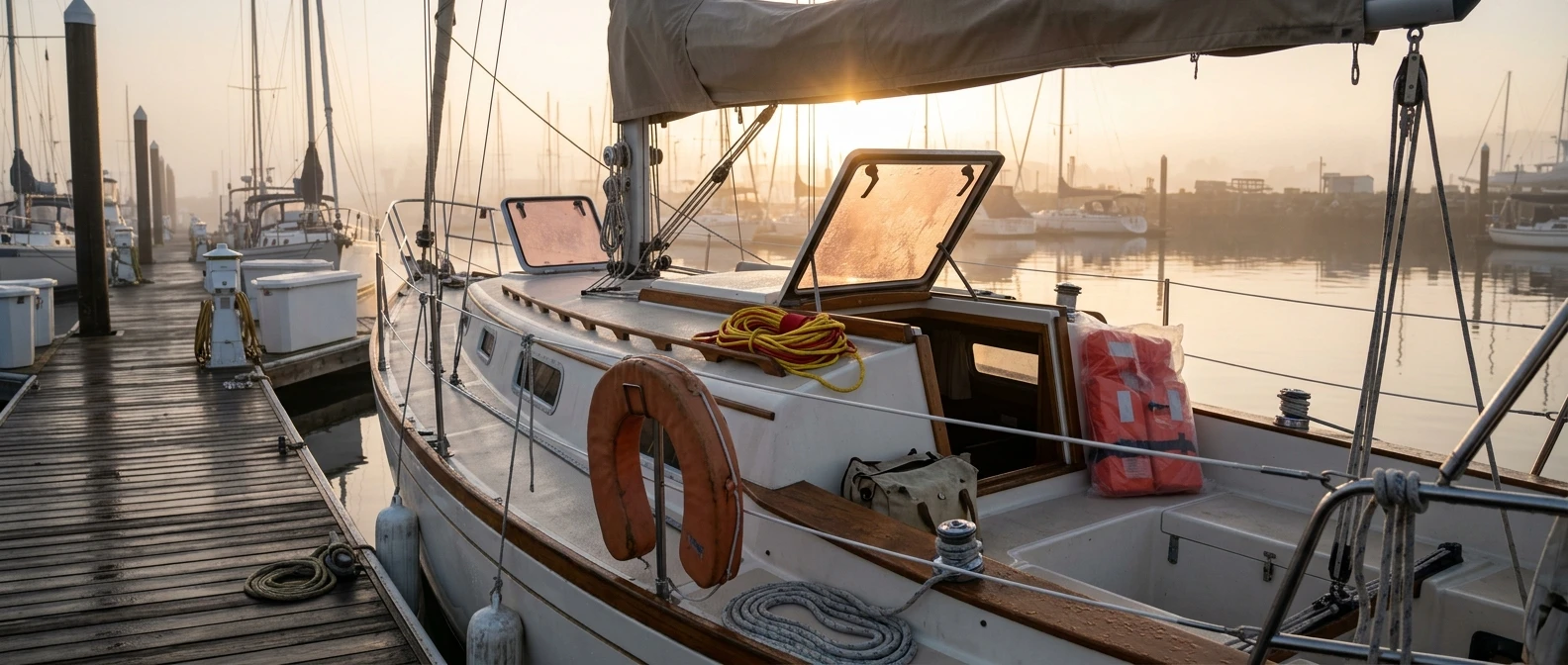
Most boats leave the dock with safety gear stowed somewhere below, still in its original packaging, untouched since the day it was bought. That gear only works if it’s worn, reachable, and understood before the first wave hits the deck. This checklist walks through what actually needs to be aboard and in working order before you cast off, not after something goes wrong.
This is a physical gear list, not a navigation guide. GPS units, chartplotters, and satellite messengers matter, but they sit in the backup layer here, alongside flares and handheld radios, because a dead phone or a cracked screen shouldn’t be the reason help doesn’t arrive.
Life jackets and inflatable PFDs that sailors actually wear
A life jacket stuffed under a v-berth cushion saves nobody. The single biggest gap in recreational boat safety isn’t the absence of PFDs, it’s PFDs that never get worn because they’re bulky, hot, or buried in a locker nobody can reach quickly.

Inflatable PFDs solved most of that problem for adult sailors. They sit low-profile around the neck and chest, inflate automatically on contact with water or manually by pull cord, and are light enough that crew will actually keep them on for an entire passage instead of shedding them the moment the coastline is out of sight. Look for a model rated for the conditions you sail in, not just the cheapest option at the chandlery, since inshore-rated inflatables often lack the buoyancy needed for offshore work.
A few points worth checking before every season, not just before every trip:
- CO2 cartridges on inflatable PFDs have a shelf life and need visual inspection for corrosion or a fired indicator.
- Oral inflation tubes should hold air without leaking when tested by mouth.
- Manual pull-cord models require the crew to know exactly where the toggle is by feel in the dark.
- Children and non-swimmers should wear solid-foam PFDs, not inflatables, since inflatables rely on a conscious user to deploy or maintain them properly.
Fit matters as much as type. A PFD that rides up around the ears in the water, or one loose enough to slip off over the head, isn’t doing its job regardless of its buoyancy rating. Try every PFD on dry land, cinch it down, and have each crew member raise their arms overhead to confirm it stays put.
Flares, EPIRBs, and PLBs: your distress signal options compared
Distress signals fall into two broad categories: things that get attention nearby, and things that get help from far away. Most boats need both, because a flare seen by a passing fishing boat and a satellite distress signal received by a rescue coordination center solve different problems.
Flares are visual and immediate. Handheld flares work at short range and are useful for confirming your position to a vessel or aircraft already searching for you. Aerial flares launch higher and are visible from much farther away, which makes them the better first signal if you’re trying to attract attention rather than confirm location. Flares expire, typically after a few years, and expired flares are a common finding during Coast Guard courtesy checks. Check the dates stamped on each one before you leave the dock, not after you need them.
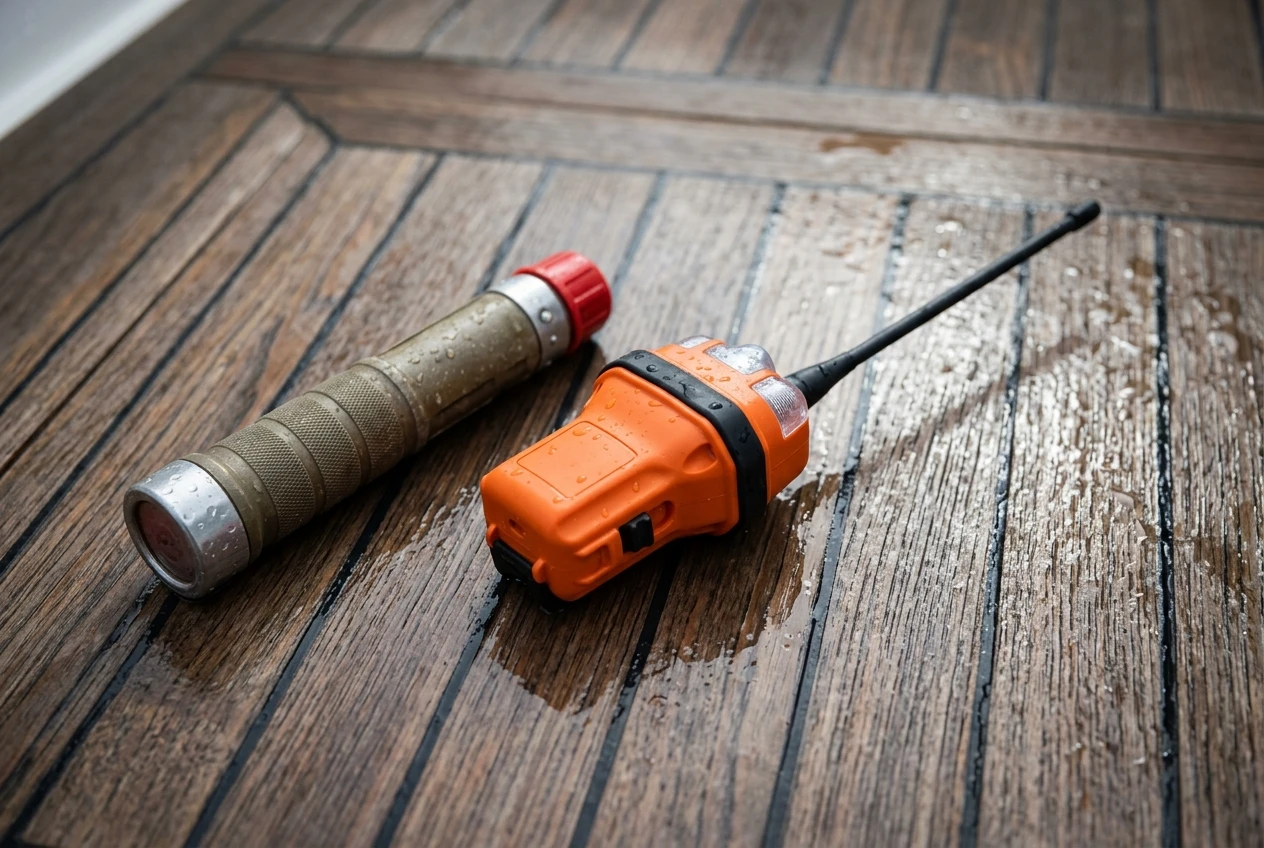
EPIRBs (Emergency Position Indicating Radio Beacons) are registered to the vessel and transmit a distress signal with GPS position to a satellite system monitored by search and rescue authorities. They’re built to float free of a sinking boat and activate automatically in some models, or manually in others. Registration matters here: an unregistered EPIRB still broadcasts a distress signal, but rescuers lose the vessel and crew information tied to that registration, which can slow response.
PLBs (Personal Locator Beacons) do a similar job but are registered to a person rather than a vessel, and they’re small enough to clip to a PFD or harness. They’re worth carrying in addition to an EPIRB, not instead of one, particularly for crew who might end up separated from the boat.
None of these replace each other. A flare gets you seen by whoever happens to be nearby right now. An EPIRB or PLB gets a rescue coordinated even if no one else is in sight. Carrying only one leaves a real gap depending on where you are when things go wrong.
Fire extinguishers and onboard fire suppression basics
Fire on a boat behaves differently than fire on land. There’s nowhere to run; fuel and electrical systems are often close together, and the materials below decks tend to burn quickly. A single extinguisher mounted somewhere convenient isn’t enough coverage for most boats over a day-sailor size.
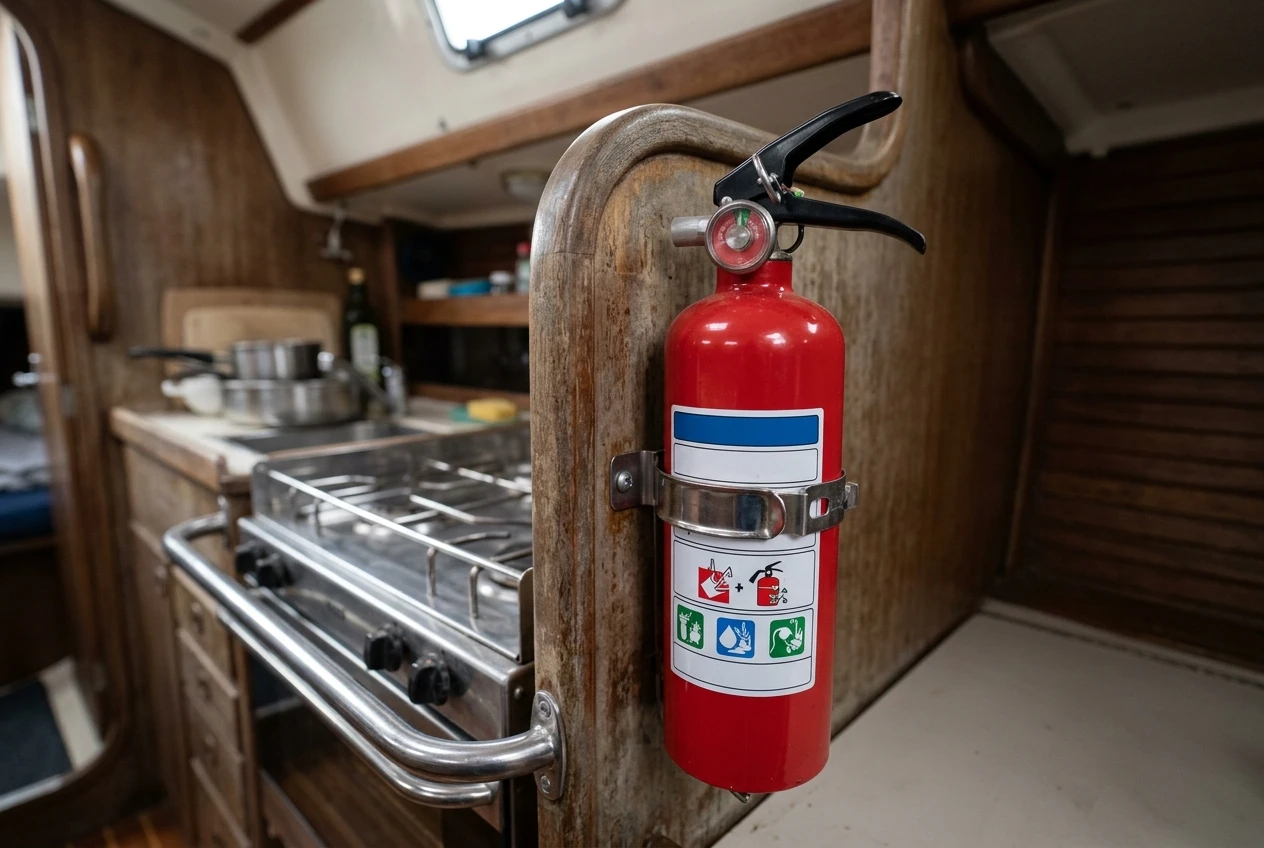
At minimum, carry a marine-rated extinguisher near the galley, since cooking fires are among the most common fire types on recreational boats, and another near the engine compartment. Dry chemical extinguishers (rated B-C or A-B-C) handle most onboard fire types, but check the specific rating against what you’re protecting against: fuel fires, electrical fires, and ordinary combustibles all need slightly different approaches.
A few maintenance habits that get skipped more often than they should:
- Check the pressure gauge monthly. A dry chemical extinguisher that’s lost pressure gives no warning other than that gauge.
- Shake dry chemical extinguishers periodically to keep the powder from settling and caking.
- Replace or recharge any extinguisher that’s been discharged, even partially, before the next trip.
- Know the expiration or service date and don’t treat it as a suggestion.
For boats with enclosed engine compartments, a fixed automatic fire suppression system is worth the investment over a handheld extinguisher alone, since engine fires often start and spread in a space the crew can’t reach quickly with a handheld unit. If your boat doesn’t have one, make sure every crew member knows where the engine compartment extinguisher access point is and how to use it without opening the compartment and feeding the fire more oxygen.
Man overboard recovery gear: tethers, horseshoe buoys, and throw lines
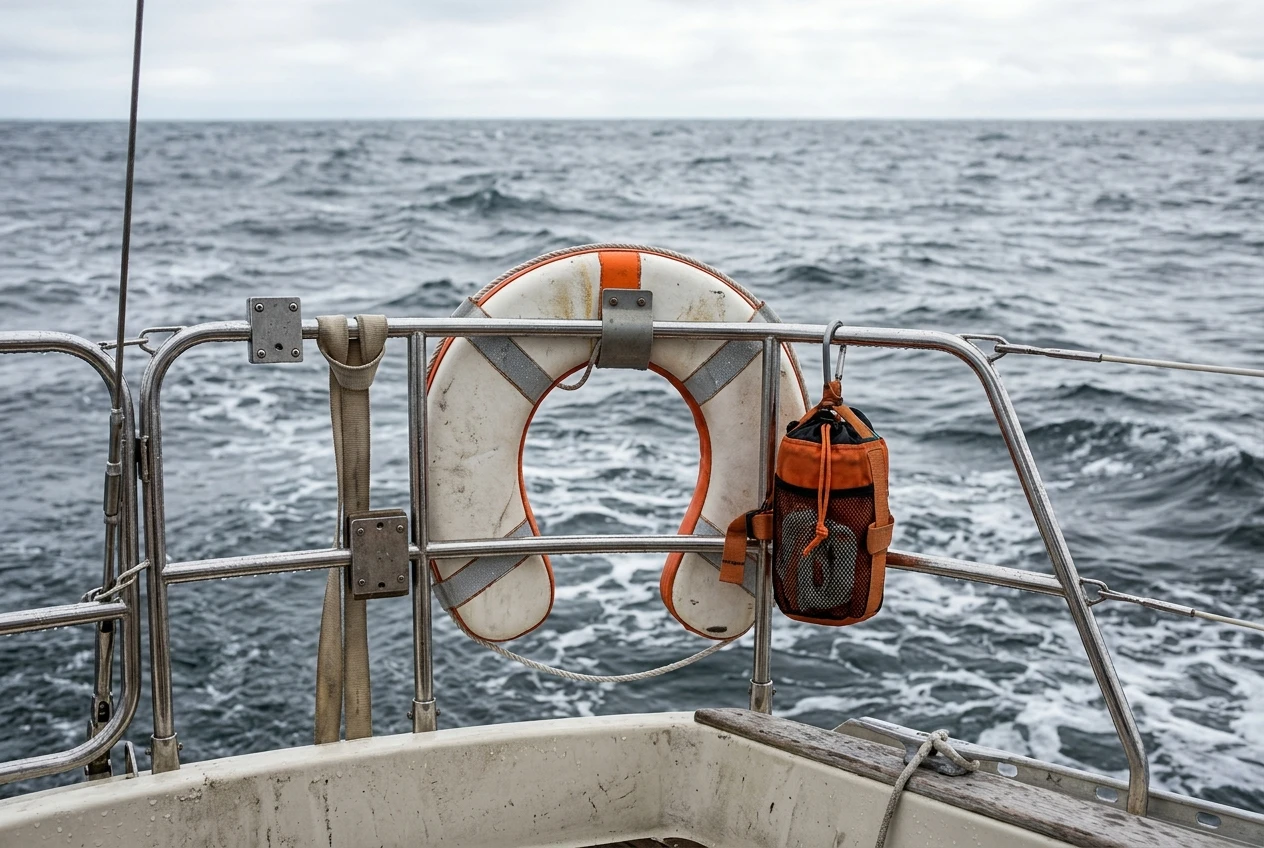
Getting someone back on the boat is harder than most sailors expect until they’ve practiced it. A horseshoe buoy or throwable flotation device should be mounted somewhere it can be grabbed and thrown in seconds, not stowed in a locker that requires unclipping or digging.
Tethers and jacklines matter most for preventing the fall in the first place. Jacklines run fore and aft along the deck, and a crew member clips a tether from their harness to the jackline before moving forward in rough conditions. The point isn’t to restrain movement; it’s to ensure that if someone does go over, they stay attached to the boat rather than drifting away while the rest of the crew tries to turn around.
A throw line, sometimes called a rescue throw bag, gives the crew a way to get flotation and a tow line to someone in the water without the boat having to maneuver directly alongside them, which is often the hardest part of a man overboard recovery under sail. Practice throwing it before you need it. A throw bag that tangles on its first real use because nobody’s tested it is a throw bag that doesn’t help.
Recovery doesn’t stop at reaching the person in the water. Getting them back aboard, especially someone exhausted, injured, or in cold water, takes more than arm strength. A few things worth having rigged or at least discussed before departure:
- A boarding ladder that can be deployed from the water side, not just the dock side.
- A lifting sling or strop for hauling an incapacitated person aboard without relying on them to help.
- A clear, practiced plan for who steers, who spots, and who handles recovery gear, decided before the emergency, not during it.
Man overboard drills feel unnecessary until the first time real conditions make the recovery harder than it looked on a calm afternoon. Running one at the start of each season, with the actual crew who’ll be aboard, is worth more than any piece of gear on this list.
Backup communication when your primary electronics fail
Primary communication on most recreational boats now runs through a VHF radio and a phone or chartplotter with cellular or satellite data. All of that depends on power, and all of it can fail at once if a battery drains, a connector corrodes, or a unit takes on water.
A handheld VHF radio, kept charged and stored somewhere accessible without opening the electronics panel, is the simplest backup. It doesn’t depend on the boat’s main electrical system, and most models float or are water-resistant enough to survive a soaking.
Satellite messengers and PLBs with two-way messaging add a layer beyond VHF range, since VHF is line-of-sight and loses range quickly beyond coastal waters. These devices let the crew send a basic message or distress signal even where there’s no cell coverage and no other boat in radio range. For a closer look at how GPS and satellite systems work together for this kind of coverage, Using GPS With Satellite Communications On Boats covers the technical side in more detail.
A printed list of emergency contact numbers and the boat’s registration and insurance details, kept with the backup radio, eliminates another point of failure. If the primary phone goes overboard with its contact list, nobody should be trying to recall a number from memory while also managing an emergency.
First aid and emergency repair supplies worth carrying
A first aid kit built for a boat needs to handle both ordinary injuries and the fact that reaching a hospital might take hours rather than minutes. A kit sized for a car glovebox is usually not sized for a day on the water, let alone an overnight passage.
Worth including beyond the basics of bandages and antiseptic:
- Seasickness medication, since an incapacitated crew member in rough conditions becomes a safety problem, not just a comfort one.
- Burn treatment supplies, given how common galley- and engine-related burns are aboard.
- A tourniquet and trauma dressing, for injuries involving winches, lines under load, or rigging failure.
- Any crew member’s personal medication, confirmed before departure rather than assumed.
Repair supplies matter for a different kind of emergency: the kind where the boat itself needs to keep functioning long enough to get back. A basic kit worth having aboard:
- Duct tape and marine sealant for temporary patches.
- Spare line and shackles sized to match what’s already rigged.
- A multi-tool or basic tool kit covering the fasteners actually used on the boat.
- A wooden bung sized to the through-hull fittings aboard, in case one fails.
None of this needs to be elaborate. It needs to match the boat, the crew, and the kind of trip being taken, checked against what’s actually aboard rather than assumed to be there from a trip months earlier.
Building a pre-departure safety check you’ll actually run every time
A safety checklist that lives in a drawer gets skipped the first time the crew is in a hurry to catch a tide or a weather window. The ones that get run every time are short, specific, and physically present where the crew can see them, usually laminated and mounted near the helm or companionway.
A workable pre-departure check doesn’t need to cover everything on this page in detail. It needs to confirm, in a few minutes, that the gear already aboard is where it should be and in working condition:
- PFDs aboard, correct sizes for all crew and guests, inflatables checked for armed cartridges.
- Flares current, stored dry and accessible.
- EPIRB or PLB charged or with current battery, registration up to date.
- Fire extinguishers charged, gauges in the green, accessible without obstruction.
- Horseshoe buoy and throw line mounted and unobstructed.
- Jacklines rigged if conditions call for them, tethers aboard and sized to the crew.
- Handheld VHF charged, satellite messenger charged and tested.
- First aid kit checked for medication expiration dates.
- Repair kit present, bung sized correctly for through-hulls aboard.
- Weather and float plan shared with someone ashore.
Add the format you’ll use most, whether that’s a laminated card at the helm or a checklist app you already run through before engine start. The format matters less than whether it actually gets run before every departure, including the short afternoon sails, when it’s easy to assume nothing will go wrong.
Turn this list into a laminated pre-departure checklist and run through it before every trip, not just the long ones.
Disclosure: This post contains Amazon affiliate links. If you buy through them, we may earn a small commission at no extra cost to you.
This article was created with AI assistance and reviewed by a human editor.
About The Author