Disclosure: This post contains affiliate links. As an Amazon Associate, I earn from qualifying purchases, at no extra cost to you. The verdict below is the same one we give friends who ask.
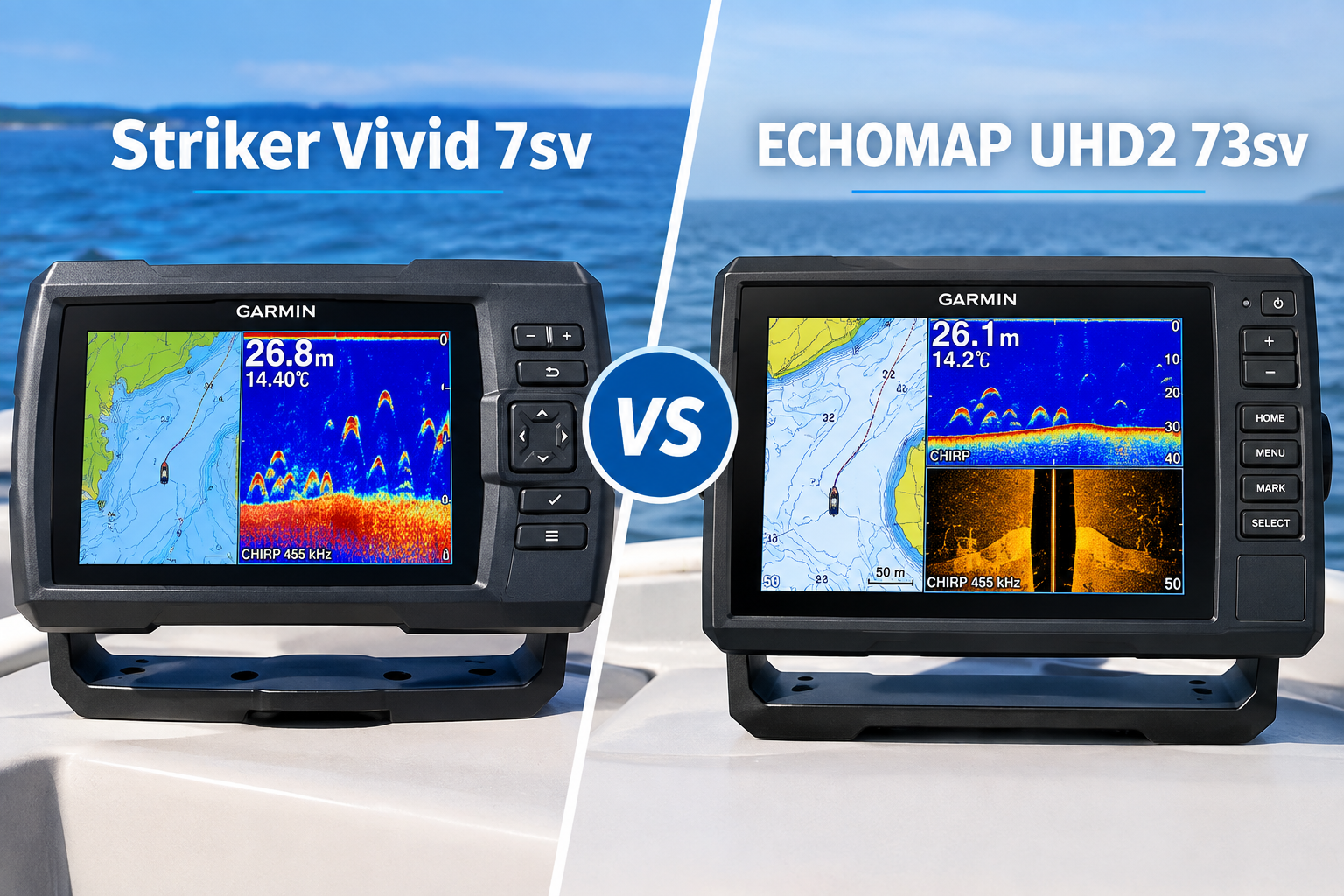
These two units sit next to each other on every marine electronics shelf, share the same 7-inch screen size, the same Garmin keypad layout, and the same “sv” side-scanning sonar promise, and one costs roughly two-thirds more than the other. Most buyers assume the ECHOMAP is simply “the better Striker”. It is not. They are different kinds of products, and which one is right depends almost entirely on one question: do you need charts?
Here is the short version, then the detail.
The 30-second verdict
Buy the Striker Vivid 7sv if you fish lakes, rivers or water you already know, you navigate by eye and by waypoints, and you want the best sonar-per-dollar Garmin makes. It is a fish finder with a built-in GPS.
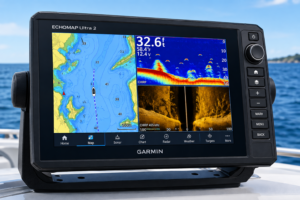
Buy the ECHOMAP UHD2 73sv if you go anywhere coastal, tidal, unfamiliar, or rocky, if you ever want to plan a route, or if you might add other electronics later. It is a chartplotter with excellent sonar in it.
→ Garmin Striker Vivid 7sv with GT52HW-TM transducer
→ Garmin ECHOMAP UHD2 73sv with GT54UHD-TM transducer
If you are choosing among more than just Garmin, our best chartplotters for small boats guide covers the broader field.
Side by side
| Striker Vivid 7sv | ECHOMAP UHD2 73sv | |
| Screen | 7″ WVGA 800×480, Vivid colour palettes | 7″ WVGA 800×480 |
| Control | Keypad | Keypad |
| Transducer in box | GT52HW-TM | GT54UHD-TM |
| Traditional CHIRP | Yes (high-wide) | Yes (high-wide) |
| ClearVü / SideVü | Yes (455/800 kHz) | Yes, Ultra High-Definition (up to 1 MHz+) |
| Preloaded charts | None | Navionics+ / BlueChart (region-specific) |
| Chart cards (microSD) | No chart support | Yes |
| Quickdraw Contours (own maps) | Yes | Yes |
| Route planning | Waypoints and go-to only | Full routes, autorouting on supported charts |
| Wi-Fi / ActiveCaptain app | Yes | Yes |
| NMEA 2000 | No | Yes |
| Networking / expansion | None | NMEA 2000 (engine data, wind, AIS) |
| Mount | Tilt/swivel bail | Quick-release bail |
| Water rating | IPX7 | IPX7 |
| Price class | Budget (~$400 class) | Mid-range (~$700 class) |
The things that are the same
Start here, because a lot of the price difference is explained by what is not different.
Both units have the same 7-inch, 800×480 display. In practice, the ECHOMAP looks a little richer because its chart rendering is more detailed, but in direct sunlight, at the same brightness, they are the same panel. Both use Garmin’s keypad interface, which is the right choice on a small open boat: wet hands, gloves, and chop all defeat touchscreens. Both have built-in GPS, both record Quickdraw Contours (you drive around, the unit builds a 1-foot contour map of your lake or bay as you go), both connect to the ActiveCaptain phone app for software updates and sharing Quickdraw maps, and both carry an IPX7 rating.
Both also come with traditional CHIRP sonar plus ClearVü (down) and SideVü (side) scanning. So on paper, the Striker gives you the ECHOMAP’s sonar toolkit for a lot less money. The reality is more nuanced, and it comes down to three things.
Difference 1: charts — the whole point
The Striker Vivid has no charts and cannot load any. Its screen shows your boat, your waypoints, your track, and the Quickdraw contours you have recorded yourself — on a blank background. That is fine on a lake you have fished for ten years. It is a serious limitation the moment you launch somewhere new, run a tidal inlet, or pick your way around a rocky point at dusk.
The ECHOMAP UHD2 73sv ships with real cartography in the US, typically Navionics+ inland or coastal, depending on the bundle; elsewhere, it includes a worldwide basemap with the option to add a regional chart card. That means depth contours, navigation aids, hazards, marinas, tide stations, and, with a Navionics+ subscription, autorouting that plots a safe route around shallows for you. Our article on using GPS to track tides and currents walks through what that looks like in practice.
If you take one thing from this comparison: the ECHOMAP is a navigation instrument; the Striker is a fishing instrument with position awareness. That is not a criticism of the Striker — it is very good at what it does — but nobody should buy it expecting a chartplotter.
Difference 2: sonar — “sv” is not “UHD sv”
Both scan sideways and downwards, but the transducers are not the same. The Striker’s GT52HW-TM runs ClearVü and SideVü at 455 and 800 kHz. The ECHOMAP’s GT54UHD-TM adds Garmin’s Ultra High-Definition scanning, which pushes frequency past 1 MHz. In water under about 30 ft — where most small-boat fishing happens — UHD produces noticeably crisper images of rock, timber, weed edges and individual fish. In deeper water, the advantage shrinks, because higher frequencies do not penetrate as far.
The Striker Vivid’s party trick is its color palettes: seven high-contrast options that make targets pop on the small screen. It is genuinely useful in bright light, and it is one reason the Vivid line reviews so well against its price.
The honest summary: the Striker’s sonar is very good; the ECHOMAP’s is better, and the gap is widest exactly where small boats fish.
Difference 3: NMEA 2000 and the future of your boat
The Striker is a sealed system sonar, GPS, and screen — nothing in, nothing out. The ECHOMAP has an NMEA 2000 port. If that means nothing to you today, it may in two years: NMEA 2000 is how the unit shows engine RPM and fuel burn, a wind sensor on a sailing boat, an AIS receiver so you can see commercial traffic, or a second display on a larger boat. It is the difference between a gadget and the start of a system.
The ECHOMAP also uses Garmin’s quick-release bail mount: one lever and the unit is in your hand, cables still attached to the cradle, which matters if you trailer the boat or leave it at a dock. The Striker’s bail needs the cables unplugged.
Where the Striker Vivid 7sv wins
It is not simply “the cheap one”. For a specific buyer it is the better choice:
- Known water. Farm ponds, reservoirs, small lakes, the river stretch you have fished all your life. Charts add nothing; Quickdraw gives you a better map than any cartographer.
- A second unit. Many bass boats run a chartplotter at the console and a Striker at the bow for the trolling motor — sonar only, where charts are irrelevant.
- Kayaks and jon boats. The savings buy a battery, a mount, and a transducer arm.
- Sonar per dollar. Nothing else at the price gives you CHIRP, ClearVü and SideVü on a 7-inch screen with Garmin’s interface.
Where the ECHOMAP UHD2 73sv wins
- Coastal, tidal, or unfamiliar water. This is not optional; it is a safety question.
- Route planning. Any trip longer than “over there” benefits from a route you can follow at night or in fog.
- UHD sonar in shallow water — the sharpest structure imaging Garmin sells at this size.
- Growth. NMEA 2000 lets the boat’s electronics grow around it.
- Resale. ECHOMAP units hold value better because the chart capability is what second-hand buyers want.
The upgrade nobody mentions: the 73sv is not the only ECHOMAP
If the 73sv is stretching the budget, the ECHOMAP UHD2 73cv drops SideVü but keeps charts, NMEA 2000 and UHD ClearVü for less, often a better buy than the Striker for a coastal boater who mainly wants to navigate. And if the console can take it, the 93sv is the same unit with a 9-inch screen, which is what a lot of 73sv owners wish they had bought.
Accessories worth adding to either
A RAM mount if you want to angle the screen or move the unit between boats; a sun cover (neither unit includes one); and for the ECHOMAP, a Navionics+ or BlueChart chart card for your region if the preloaded bundle does not cover it. For a kayak or jon boat, a small 12 V LiFePO4 battery runs either unit all day.
→ RAM mount for Garmin 7-inch units
→ Garmin 7-inch sun cover
→ Navionics+ chart card
Final verdict
If money were no object, everyone would buy the ECHOMAP UHD2 73sv; it does everything the Striker does and adds navigation, sharper sonar, and expansion. But money is usually the object, and the honest guidance is this: if you would ever use a chart, the extra cost is the cheapest safety equipment on the boat; if you never would, the Striker Vivid 7sv is one of the best-value fish finders on the market and you should not feel you are settling.
→ Garmin ECHOMAP UHD2 73sv — our pick for coastal and unfamiliar water
→ Garmin Striker Vivid 7sv — our pick for known water and tight budgets
Disclosure: As an Amazon Associate, gpsnavigationsite.com earns from qualifying purchases made through links in this article. Specifications and bundles are accurate at the time of publication; Garmin changes transducer and chart bundles by region and over time.
This article was created with AI assistance and reviewed by a human editor.
About The Author