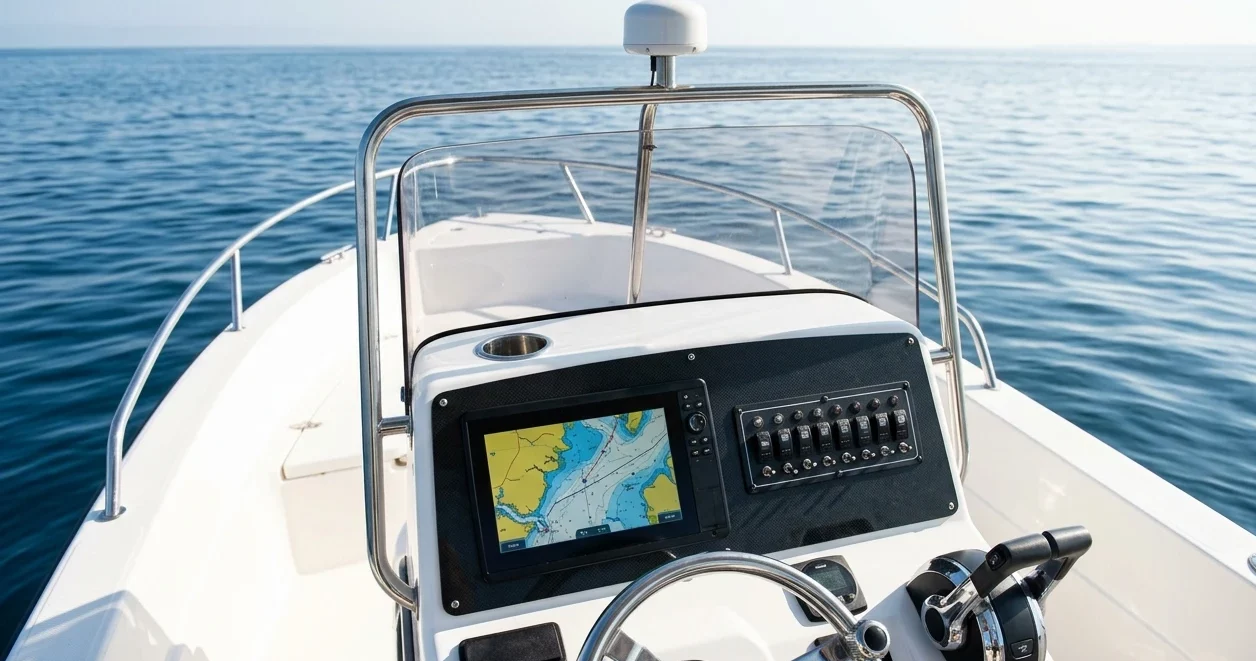

As already promised, I’d like to write a more or less detailed overview of my sea voyage as a skipper on a Jeanneau Prestige 36 powerboat.

Who knows, maybe the information I shared in those posts could help with future sea voyages anywhere in the world.
It took place in the summer of 2009, and the route was from Riga, the capital of Latvia on the Baltic Sea, to Lowestoft, the UK, on the west coast of the North Sea.
Riga
„After seven centuries of foreign domination,the Republic of Latvia (Latvijas Republika) is independent since 1991 and has been transforming herself into an economically dynamic democracy. The vehicle for this transforming is the capital Riga, the largest city in the Baltic States.
Of Latvias 2.350.000 inhabitants approx. 750.000 live in Riga. The city is located on both banks of the river Daugava which separates the city into two parts, Vecriga (Old Riga) and Pardaugava. Four bridges, one only for railway traffic, connect the banks.
Riga is close to the Gulf of Riga at the Baltic Sea and the harbour is an important part of the citys development. Once the river was an important as a strategically location called the Amber Way where the Nordic Vikings started their travels east). Today you find in the very heart of the city, just at the doorsteps to the Old Town, the Sea Passenger Terminal. Riga is also a hub for both the domestic and international trains. Only twenty minutes away from the city centre you find the biggest airport in the Baltic States, Riga International Airport.“ (www.riga.com)
I was invited as a skipper to navigate this adventurous and a bit risky maritime journey. From the beginning, I was doubtful a little, but the spirit of adventure and a relatively large reward took the upper hand, and I agreed to make the sea journey.
In fact, it was a unique opportunity because it was an expensive pleasure and an ordinary person would not have been able to afford it. Boat owner was a wealthy local entrepreneur who wanted to invite their foreign friends to hunt and to fish in England and perhaps to boast with its beautiful power boat.
Even more, I also wanted to prove to myself that I could do it.
I had, if I’m not mistaken, about a week to prepare. One might think that’s not so little, but I needed to gain some practical experience handling this particular ship. The boat wasn’t very big, only 36 feet, but the engine output was decent, about 620 kW, and you need to know how to handle that much power. I had not much experience with powerboats. I was familiar with cruising sailboats and even navigating hundreds of feet-long merchant cargo ships.

I made a couple of short training trips along the lake and a short sea voyage to check the boat’s seaworthiness. I was satisfied with the results. The boat handled waves well, and I was convinced she could safely navigate up to a Beaufort Sea State 6.
Nautical charts and marine navigation software.
For me, as the professional marine navigation officer, safe route planning was crucial. It means preparing updated Nautical maps for the planned route and adjacent areas. The boat has a factory-installed Raymarine GPS chartplotter, which I was familiar with; the chart cartridges, however, did not match the planned voyage.
I did internet research to find those maps, and the Estonian branch of C-MAP
Jeppesen offered me three, with the latest chart corrections; I needed CMAP NT+ cartridges for about € 500 (about $ 565). Expensive, yes, for that is a crazy price tag. Actually, these three C-MAP cartridges, used on one voyage, are still in my vault.

So the Raymarine GPS chartplotter was good for the voyage, but I had to be ready with a backup solution, since traditional navigation sea charts weren’t available. Luckily, I had an Acer Windows laptop with MaxSea navigation software.
I used it as a route-planning tool for sailing regattas, mainly in the Baltic Sea region. Today I prefer MacENC Marine Navigation Software as it fits for MacBook use. But MaxSea navigation software is good enough for safe navigation and route planning.
Even, even more, I was recently purchased Navionics Baltic Sea App for iPhone 3. Great application. Today I sometimes use Navionics Europe as it covers all European waters and is very convenient as a mobile navigation device. With those independent tools on board, I assume that navigation is more or less OK.
The next headache was fuel.
I had to make the proper calculation how much, how long distances and were to make refueling. It is one of the big inconveniences of powerboats of this size. Fuel consumption is significant, but the fuel tank capacity isn’t big enough for long offshore sailing.
Before looking for stopovers, I researched expected marinas’ refueling facilities, and I was surprised that not every marina, even in Germany, offers this service.
For my boat, at a cruising speed of 20 knots, fuel consumption is about 80 liters per hour, but the two fuel tanks have a combined capacity of 800 liters. That’s about 200 nautical miles total, plus 100 liters spare in five cans. It is almost impossible to fill this volume at a public gas station, and as I said, not every Marine has fuel pumps to fill 800 liters (211 gallons, US) of diesel safely.
I called the first two stopovers, Pavilosta, Latvia, and Leba, Poland, and got confirmation about refueling. For the next stops in wealthy countries such as Germany, Holland, and the United Kingdom, I was sure that no problems with diesel fuel accessibility would arise.
In fact, the reality was not so bright. I had a big problem refueling in many rich seaports, such as Cuxhaven in Germany, located on the banks of the Elbe estuary. About it, when my story about sea voyage will reach that leg of the route.Although time has passed, and perhaps the situation has changed today.
I was almost ready for a great adventure on the sea voyage aboard the Jeanneau Prestige 36 powerboat, covering about 2000 nautical miles in the Baltic Sea and the North Sea.
About the boat.
Builder- JEANNEAU

Model- PRESTIGE 36
Year of built-2004
Length overall-11.13 m/36 ft
Breadth-3.84 m
Draught-0.93 m
Air draught- 3.43 m
Displacement-7.800 tons
Engine-2 VOLVO PENTA
diesel 620 KW
Fuel capacity-800 lt
Freshwater capacity-400 lt
Accommodation
Four berths in two cabins
Diesel cabin heating with screen demisters
Removable saloon carpet over polished wooden floor
Polished stainless steel framed sliding saloon doors

Forward owners cabin with large island double berth
Opening porthole, deck hatch

Second cabin with hanging locker
Opening porthole
Lower helm with double helm seat
Engine instrumentation and navigation equipment
Extendable saloon table to starboard with storage under seating
Settee to port
Cream leather upholstery
Galley with 2 x stainless steel sinks
Gas cooker with three burner hob
Combi microwave oven

12v Fridge
And to end the first part of my story, we were four people on board. Me, the owner’s friend, and two sailors with little to no marine skills. As a result, almost all navigation fell on my shoulders, although most of it was meant to be done during the day.
Now I just need to wait until I have the willpower to write more about the actual sea-voyage stories. I hope not as long.
About The Author


Hi Andrel, Interesting to read of your involvement with your boat. I hope that your journeys never get too scary, particularly with all of the modern radar and gps helping you to go where you need to go and avoid collision etc. I look forward to your next installment! I would be more than interested in how the gps responds on such journeys.
Thanks Ian for stopping by!
I will try to write all my adventures with my sea voyage on this powerboat. Luckily it is still very fresh in my memory. GPS navigation system is the very helpful tool, but I am good enough to navigate in old fashion mode using paper charts, compass, and sextant.
Hi, very interesting as I’m in the process of buying one of these boats, I happened upon your page from a YouTube video when I was researching the boat. Now the strange part, I’m an englishman living in Stockholm and the boat I found apparently came from Riga, I wonder if it could be the same boat? I have a picture of when it was in dry storage with an ID number LU 5620. Does that sound familiar? I would like to know more about the history of the boat if it is the same one, I have test driven it and am having it surveyed on Monday. I would also like to discuss fuel consumption and cruising speeds with you if that’s OK? This one also has the D6 310 engines. Best regards, Stuart.