Disclosure: This post contains affiliate links. As an Amazon Associate, I earn from qualifying purchases at no extra cost to you.
Anyone who has sledded for a few seasons knows how quickly the landscape can change. A trail junction you’ve passed a dozen times looks completely different in flat light. Blowing snow can erase your tracks within minutes, and the sun seems to set an hour earlier than you planned. In those moments, a reliable snowmobile GPS can decide whether you get home on time or spend a long, cold night in the woods.
This guide covers the best GPS for snowmobiles that riders are buying on Amazon right now. It includes purpose-built powersport navigators, rugged handhelds with satellite SOS, and a budget unit for riders who only need basic tracking. You’ll also find a buying guide to help you match the device to how and where you actually ride.
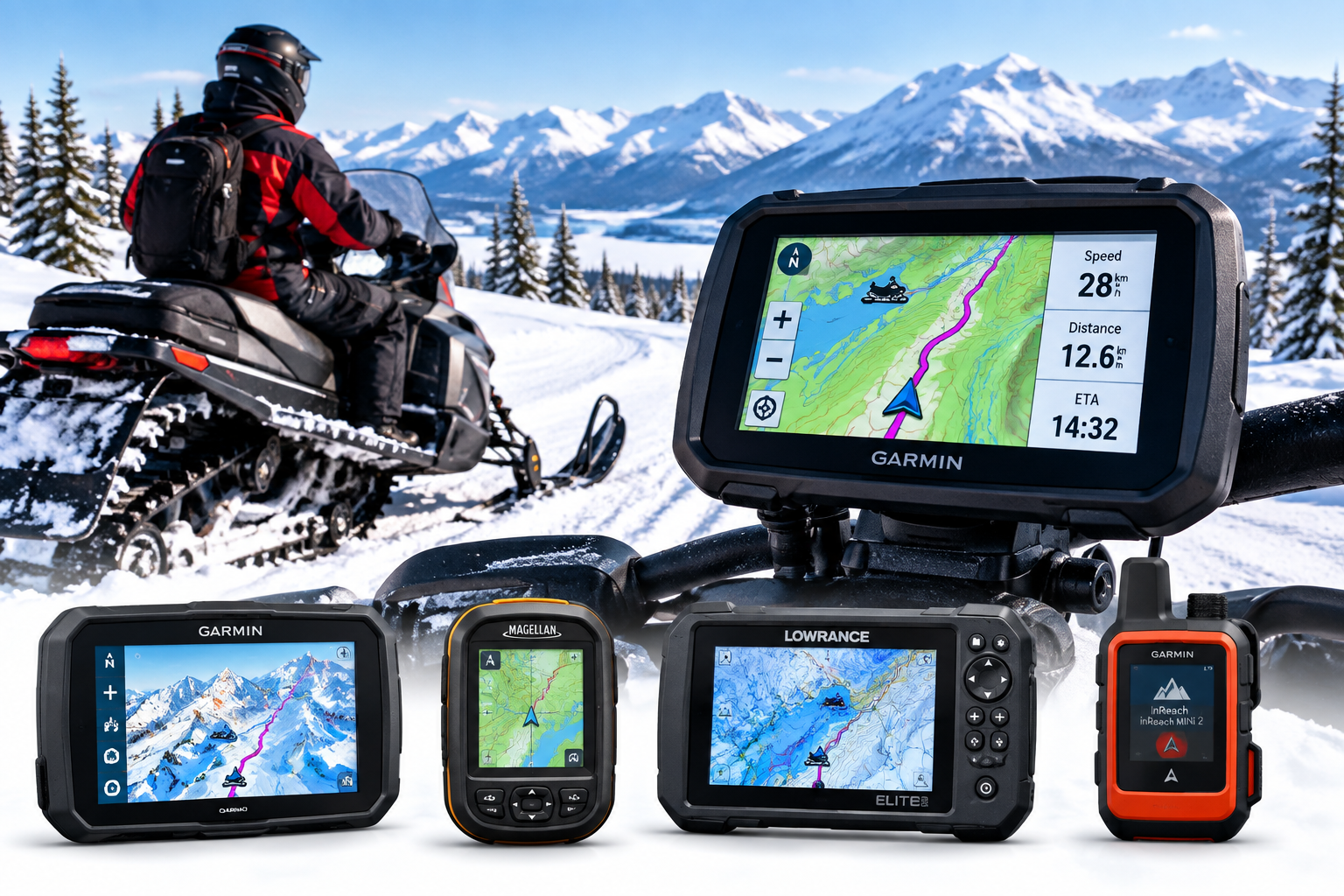
Quick Picks: Best Snowmobile GPS at a Glance
| GPS | Type | Best For |
|---|---|---|
| Garmin Tread 2 Powersport | Mounted Powersport navigator | Best overall for trail riders |
| Garmin Montana 760i / 710i | Rugged handheld with inReach | Best for backcountry and remote riding |
| Garmin GPSMAP 67i | Button-operated handheld with inReach | Best for glove use and long battery life |
| Garmin zūmo XT3 | Rugged motorcycle navigator | Best for riders who also ride motorcycles |
| Garmin inReach Mini 3 Plus | Satellite communicator | Best safety add-on for any sled |
| Garmin eTrex 22x | Budget handheld | Best budget snowmobile GPS |
Why Use a Dedicated Snowmobile GPS Instead of Your Phone?
Many riders start with a phone on a handlebar mount, and many switch to a dedicated GPS after one bad day. Phone batteries drain fast in sub-zero temperatures. Touchscreens don’t respond well to thick gloves, and most navigation apps depend on a cell signal that disappears as soon as you leave the main trail system.
A dedicated snowmobile GPS avoids those problems. It uses satellites directly, works with no cell coverage, and is sealed against snow and moisture. Most units can also be wired to your sled’s power supply. Many riders who have used both say the same thing: a phone is fine as a backup, but it shouldn’t be your only way to navigate. Riders on the Ski-Doo forums, for example, report years of reliable use from Garmin’s rugged Montana handhelds. One long-time rider called the Montana 600 series very durable and waterproof after years on the trail. Ski-Doo Snowmobiles Forum
The Best GPS for Snowmobiles: In-Depth Reviews
1. Garmin Tread 2 Powersport Navigator – Best Overall Snowmobile GPS
If you mostly ride groomed trail systems and want turn-by-turn navigation made for sleds, the Tread 2 is the easiest recommendation. It is also one of the most popular snowmobile GPS units on Amazon. Garmin built it for powersports rather than adapting a car or hiking unit.
The Tread 2 is designed for snowmobile, side-by-side, ATV, UTV, and motorcycle riders, with an ultrabright 6-inch touchscreen, turn-by-turn navigation, and topographic maps. The screen is the headline feature. It remains readable in direct sunlight, works while you’re wearing gloves, and has an IP67 dust-and-water rating. That combination matters when you’re squinting at the screen on a bright snowfield. GarminGarmin
The main reason to buy it is the snowmobile trail content. It shows snowmobile trails for selected areas along with sled-friendly stops such as fuel stations, warming shelters, and restaurants. Coverage has expanded beyond the U.S.: the trail data now includes selected areas across the US and Canadian provinces.
Backcountry riders get useful extras too. It supports Outdoor Maps+, a paid subscription that adds premium layers such as slope angle, slope aspect and avalanche risk reports. Built-in sensors include an altimeter, barometer, compass and pitch/roll gauges. AmazonGarmin
For group riding, you can pair the Tread 2 with a Group Ride Radio outside cell coverage to share locations with your group and talk through the included push-to-talk fist mic. Garmin also sells a handlebar controller so you can operate the map without taking your hands off the grips. At launch, the Tread 2 had a suggested retail price of $699.99, and the Handlebar Controller was $149.99.
Pros:
- The bright 6″ screen is easy to read and works with gloves
- Snowmobile trail maps and sled-specific points of interest come preloaded
- Group ride features and a handlebar controller are available
- Optional avalanche and slope-angle maps are useful for backcountry riders
Cons:
- Needs vehicle power for all-day use. The internal battery lasts up to about 7 hours, or roughly 5 hours at full brightness. The GPS Store
- Trail coverage depends on your region, so check your area before buying
Best for: Trail riders in the northern U.S. and Canada who want true turn-by-turn snowmobile navigation.
2. Garmin Montana 760i / 710i – Best GPS for Backcountry Snowmobiling
The Montana has been a favorite among sledders for more than ten years, and the newest generation is the best version yet. Unlike the Tread 2, it is a handheld. You can mount it on the sled, then unclip it and take it with you if you have to leave the machine behind. For a backcountry rider, that difference matters a lot.
Its most important feature is satellite communication. The Montana 710i and 760i include built-in inReach technology. With an active subscription, you can send two-way texts, share your location over the global Iridium satellite network, and send an interactive SOS to Garmin’s 24/7 emergency response center. If you’re stuck in a drainage with no cell signal, that feature is the reason to own this unit.
Battery life is another major advantage. It increased from 18 hours on the previous Montana to 24 hours in GPS mode, and up to 440 hours in expedition mode. The two “i” models are almost identical. The main difference is the 8MP geotagging camera on the 760i, which the 710i doesn’t have. Both have the same 5-inch dual-orientation touchscreen, 24-hour battery and 32GB of memory. GPS
Suggested retail prices for the Montana 710, 710i and 760i range from $649.99 to $899.99. The Montana 710 without inReach is the lowest-priced model, but most snowmobilers should choose the 710i for the satellite messaging and SOS.
Pros:
- Satellite SOS and two-way messaging work anywhere on Earth
- 24-hour battery life is excellent for long days
- You can carry it off the sled in an emergency
- It is proven, rugged hardware that sledders trust
Cons:
- Bulky and heavy. One reviewer weighed it at 14.5 ounces.
- inReach features require a paid subscription
- Snowmobile trail maps usually require a third-party map add-on
Best for: Mountain and backcountry riders who need navigation and emergency communication in one device.
3. Garmin GPSMAP 67i – Best Button-Operated Snowmobile GPS
Touchscreens and heavy winter gloves don’t always work well together. The GPSMAP 67i uses physical buttons, so every function works with big mitts on, even when snow or ice is covering the screen. It also includes inReach satellite messaging and SOS in a smaller body than the Montana.
The trade-off is screen size. The display is much smaller than the Montana’s or the Tread 2’s, which makes it better for checking your position and following a track than for studying detailed trail networks at speed. Battery life is one of its strengths, and it’s a good choice for riders who want one device for sledding, hunting and hiking. It is also usually cheaper than the Montana 710i. Recent retail listings have shown it at around $580.
Pros:
- Buttons work reliably with any gloves
- Includes inReach satellite messaging and SOS
- Very long battery life
- Compact and easy to keep in a jacket pocket
Cons:
- Small screen for trail navigation
- Requires an inReach subscription for satellite features
Best for: Riders who want dependable glove-friendly operation and satellite safety in a pocket-sized unit.
4. Garmin zūmo XT3 – Best for Riders Who Also Ride Motorcycles
If your sled sits in the garage from April to November while you ride a motorcycle, the zūmo XT3 lets you use the same navigator year-round. It is Garmin’s newest rugged motorcycle GPS, and it holds up well in winter conditions.
Garmin offers the XT3 with either a 4.7-inch or 6-inch glove-compatible touchscreen and says it is built to handle handlebar vibration, rough terrain and poor weather. It meets MIL-STD-810 drop standards and has an IPX7 water-resistance rating. It ships with street maps and high-definition topo maps preloaded, and you can download satellite imagery directly to the device.
For snowmobile use, you can import trail files. The XT3 supports GPX, KML and KMZ imports, and it has a compass-only mode that gives direction and distance without a mapped route. That makes it compatible with third-party snowmobile trail maps. The 4.7-inch model launched at $499 and the 6-inch model at $599.
Pros:
- One device for motorcycle and snowmobile seasons
- Rugged and vibration-resistant
- Imports GPX trail files and has a compass-only mode
Cons:
- Doesn’t include Garmin’s snowmobile trail content as the Tread 2 does
- Several of its motorcycle features aren’t useful on a sled
Best for: Year-round riders who want a single navigator for both two- and four-season use.
5. Garmin inReach Mini 3 Plus – Best Safety Add-On for Any Snowmobile
This isn’t a full trail navigator, but many experienced riders consider it the most important electronic device they carry. If you already have a mounted GPS without satellite communication, or you rely on your sled’s built-in display, a small inReach communicator gives you SOS capability for a much lower cost than replacing your navigator.
The newest model is a significant upgrade. The inReach Mini 3 Plus has a color touchscreen, a built-in speaker and microphone, and can send voice messages, texts and photos. You can also trigger an interactive SOS to Garmin’s response center. Garmin rates it for up to 330 hours of battery life in 10-minute tracking mode. It is built for extreme temperatures, impact-resistant, and IP67-rated.
There are two versions. The base Mini 3 costs $449, and the Plus costs $499. The base Mini 3 leaves out the voice and photo features but keeps everything else. If you’re on a tight budget, the older inReach Mini 2 is still sold and often discounted.
Pros:
- Global SOS and messaging in a pocket-sized device
- Excellent battery life
- Works with any navigation setup
Cons:
- Only basic navigation, not a trail map GPS
- Requires a satellite subscription
Best for: Any rider who travels beyond cell coverage. Keep it on your body, not on the sled.
6. Garmin eTrex 22x – Best Budget Snowmobile GPS
Not everyone needs a $700 navigator. If you mostly ride familiar local trails and want a device that records your tracks, marks waypoints, and gets you back to the truck, the eTrex 22x does the job for a fraction of the cost. Recent listings have shown it at about $194.
It uses buttons, so gloves aren’t a problem. It also runs on AA batteries, which is a real advantage in winter: you can carry spares and swap them in seconds. Lithium AA cells hold up much better than alkaline batteries in extreme cold. Its small screen and lack of turn-by-turn routing mean it’s a tracking and backtrack tool rather than a trail navigator. You can still load third-party trail maps onto it.
Pros:
- Very affordable
- Swappable AA batteries work well in cold weather
- Button controls work with gloves
Cons:
- Small screen, no turn-by-turn trail routing
- No satellite communication
Best for: Casual trail riders and anyone who wants a reliable backup GPS.
Snowmobile GPS Buying Guide: What to Look For
1. Maps and Trail Coverage
The maps matter more than the hardware. A GPS is only as useful as the trail data you load on it. Before buying, check whether trail coverage exists for where you ride. Garmin’s Tread lineup includes snowmobile trail content for selected U.S. and Canadian regions. For other devices, riders often use third-party map providers. GPS Trailmasters, for example, sells routable snowmobile trail maps for Maine, New Hampshire, Vermont, Massachusetts, New York, Pennsylvania, Quebec, and New Brunswick. In some states, local mapping providers are the most popular choice, so check your state snowmobile association’s resources.
2. Screen Size and Glove Compatibility
Bigger screens, 5 inches and up, are much easier to read at speed and at a glance. Test how the unit works with your actual riding gloves. Purpose-built powersport navigators have glove-friendly touchscreens. Button-operated handhelds work reliably with any gloves or mitts.
3. Cold-Weather Battery and Power
Cold drains lithium-ion batteries fast. For a mounted navigator, plan to hardwire it to the sled’s 12V system. Some sleds, especially older or lightweight models, don’t have a battery, so you may need a specialized power solution. One installer notes that it offers a dedicated power setup for sleds without a battery. For handhelds, keep a spare power bank in an inside pocket where your body heat keeps it warm.
4. Mounting and Vibration Resistance
Snowmobiles vibrate constantly and hit hard in moguls. Use a quality mount, such as a RAM-style ball mount or a manufacturer-specific kit, and put it where you can see it without looking far from the trail. Many riders mount the GPS on a glovebox extension or on the handlebar riser.
5. Satellite Communication (inReach)
If you ride anywhere without reliable cell coverage, whether that’s in the mountains, northern forests, or on frozen lakes, strongly consider a device with satellite SOS. A built-in inReach adds to the upfront price and requires a subscription, but it’s the one feature you hope you never need and will be very glad to have if you do.
6. Waterproofing and Durability
Look for an IP67 or IPX7 rating at minimum. Snow melts on warm electronics, refreezes, and gets into seams. A properly sealed unit handles that without trouble.
Tips for Using a GPS on Your Snowmobile
- Load your maps before the season. Update firmware and trail maps in the fall, not in a hotel parking lot on the first day of riding.
- Save your trailhead as a waypoint. It takes five seconds and makes backtracking simple.
- Record every ride. Saved tracks build a personal map of your riding area over time.
- Carry a backup. A second device, a phone with offline maps, or a paper trail map can help if your main unit fails.
- Share your plan. Tell someone where you’re riding and when you expect to return, even if you carry a satellite SOS device.
Frequently Asked Questions
What is the best GPS for snowmobiles?
For most trail riders, the Garmin Tread 2 Powersport is the best overall choice because it has sled-specific trail maps, a large glove-friendly screen, and Powersport mounting. For backcountry riders, the Garmin Montana 710i or 760i is the better choice because it adds satellite SOS and long battery life.
Can I use my phone as a snowmobile GPS?
Yes, with limitations. Phone batteries drain quickly in the cold, touchscreens are hard to use with gloves, and many apps need a cell signal. Use offline maps and keep the phone warm if you rely on it, but don’t make it your only navigation tool.
Do snowmobile GPS units work without cell service?
Yes. Dedicated GPS units receive signals directly from satellites, so they show your position and maps with no cell coverage. Features like live weather and phone-based group tracking do need a connection.
Does a snowmobile GPS need a subscription?
Basic navigation doesn’t. Satellite messaging and SOS on inReach devices need an active subscription, and some premium map layers, such as Garmin’s Outdoor Maps+, are also paid.
Where can I get snowmobile trail maps for my GPS?
Garmin Tread devices include trail content for selected U.S. and Canadian regions. For other GPS units, look at third-party providers such as GPS Trailmasters, or check with your state or provincial snowmobile association.
Final Verdict
The best GPS for snowmobiles depends on where you ride. Groomed-trail riders will get the most from the Garmin Tread 2 Powersport because of its trail maps, bright screen, and sled-friendly design. Backcountry and mountain riders should choose the Garmin Montana 710i or 760i, or the more compact GPSMAP 67i, because satellite SOS matters as much as navigation. Riders on a budget can start with the eTrex 22x. Whatever you ride, an inReach Mini 3 in your pocket is inexpensive insurance.
Choose the one that fits your riding, load your maps before the snow falls, and enjoy the trails.
Disclosure: This post contains affiliate links. As an Amazon Associate, I earn from qualifying purchases at no extra cost to you.
This article was created with AI assistance and reviewed by a human editor.
About The Author