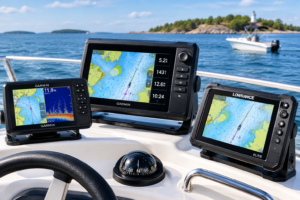
The Lowrance Eagle Eye 9 fishfinder with Live Sonar has done something the fishing electronics market hadn’t seen before: it crammed professional-grade forward-facing sonar, CHIRP technology, and DownScan Imaging with Fish Reveal into a single, module-free unit priced under $1,100.
For years, live sonar was the exclusive weapon of tournament pros and well-heeled weekend warriors willing to drop $2,000–$3,000 on a Garmin Livescope or Humminbird MEGA Live system. The Eagle Eye 9 blows that barrier wide open. Whether you’re chasing largemouth from a kayak on a shallow inland lake or finesse fishing structure from a jon boat, this compact 9-inch unit promises to put real-time fish tracking in the hands of anglers who never thought they could afford it. In this deep-dive review, we’ll cover everything from sonar performance and mapping to pros and cons, real customer feedback, top competitors, and exactly where to buy it at the best price.
What Is the Lowrance Eagle Eye 9?
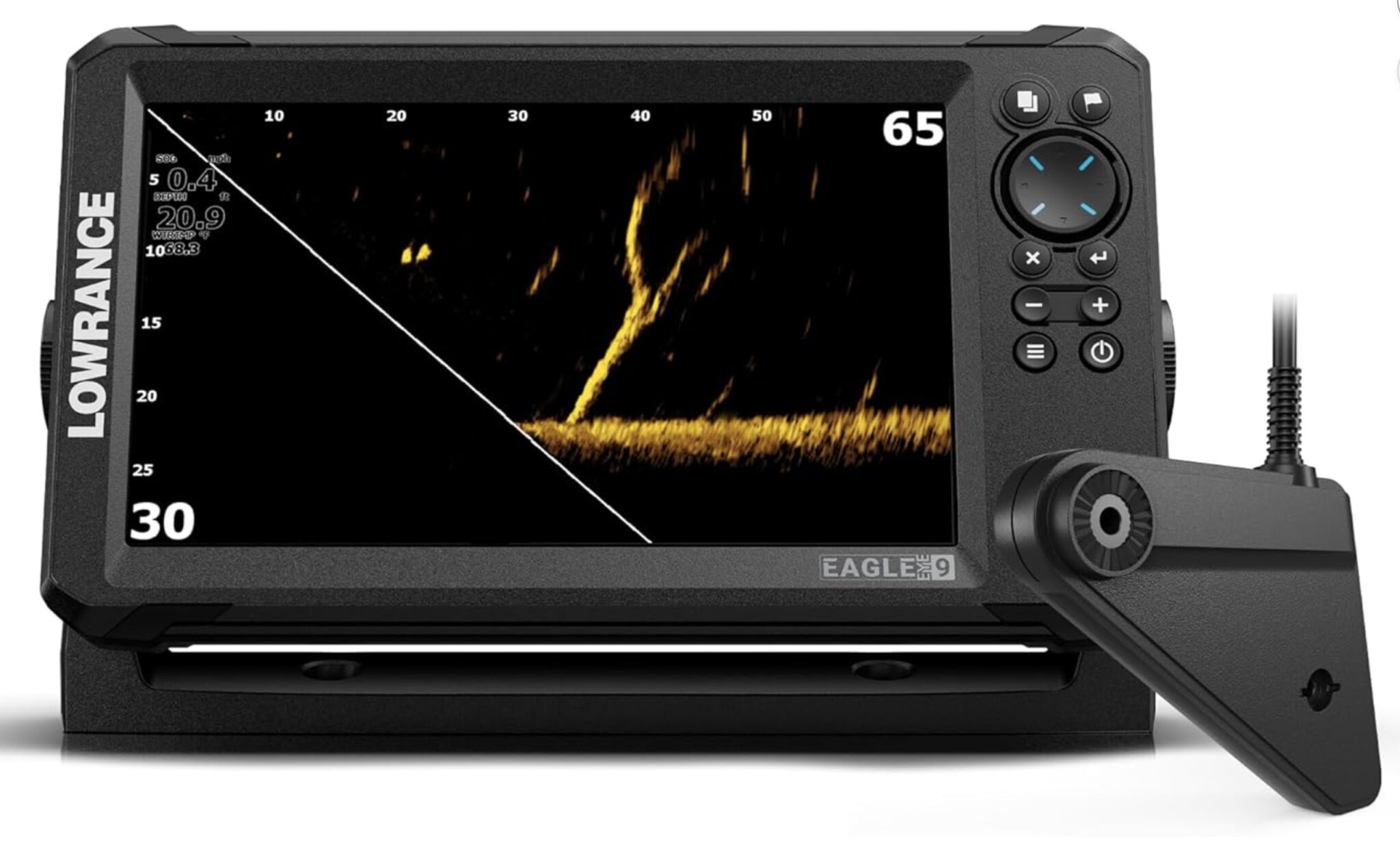
Launched as the entry point into Lowrance’s Eagle lineup, the Eagle Eye 9 is a 9-inch fishfinder/chartplotter that delivers four sonar views from a single transducer — no external black box or module required. Those four views are:
- Live Forward — real-time video-like imaging of what’s happening ahead of your boat, up to 60 feet out
- Live Down — vertical live sonar directly beneath the transducer
- CHIRP Sonar — traditional broadband sonar delivering crisp fish arches and structure definition to 500 ft (CHIRP) and 300 ft (DownScan)
- DownScan Imaging with FishReveal — photographic-quality bottom imaging overlaid with CHIRP data to highlight fish in cover with an orange tint
The display is a 9-inch IPS panel running at 1024 × 600 resolution with 1000 NITS brightness and 85° viewing angles, bright enough to read in direct sunlight even through polarized sunglasses. The whole unit weighs just 1.98 lbs and draws only 650 mA, making it ideal for smaller vessels and kayaks.
Retail price: $999.99, often found at $1,049 with the C-MAP Discover OnBoard chart bundle included.
Key Specifications at a Glance
| Specification | Details |
|---|---|
| Screen Size & Type | 9-inch IPS |
| Resolution | 1024 × 600 px |
| Brightness | 1000 NITS |
| Sonar Technologies | Live Forward, Live Down, CHIRP, DownScan w/ FishReveal |
| Transducer | Single unit, no module needed |
| Max Depth (CHIRP) | 500 ft (152 m) |
| Max Depth (DownScan) | 300 ft (91 m) |
| Live Sonar Range | ~60 ft optimal, up to ~80 ft |
| Preloaded Charts | C-MAP Discover OnBoard — 17,000+ U.S. inland lakes |
| Custom Mapping | Genesis Live (0.5-ft real-time contours) |
| MicroSD Slot | Up to 32 GB |
| Power | 12V DC (10.8–17V), 650 mA max |
| Waterproofing | IPX7 |
| Weight | 1.98 lbs (0.9 kg) |
| Warranty | 1-year base (extendable to 5 years) |
Sonar Performance: What Sets the Eagle Eye 9 Apart
Live Forward Sonar
This is the headline feature — and it earns the attention. Live forward sonar shows fish and structure in real time ahead of the boat, with movement you can actually watch. It’s the technique that took tournament bass fishing by storm, letting anglers see a bass react to a lure before they feel anything on the line. The Eagle Eye 9’s live forward sonar uses two crystals (compared to six on Lowrance’s premium ActiveTarget system), which means resolution is more focused and functional rather than broadcast-wide. In water shallower than 50 feet — the sweet spot for most inland bass, crappie, and walleye anglers — it’s remarkably effective.
CHIRP Sonar
The CHIRP sonar on the Eagle Eye 9 sweeps a range of frequencies simultaneously, producing tighter, better-separated fish arches and more detailed bottom composition than traditional single-frequency sonar. It handles depths up to 500 feet, making it genuinely useful even when the live sonar is reaching its limits.
DownScan Imaging with FishReveal
DownScan delivers near-photographic images of structure below — submerged timber, rock piles, grass beds, dock pilings. On its own, DownScan is excellent at showing where the structure is. FishReveal layers CHIRP data on top of the DownScan image, tinting fish targets orange so they stand out against the background. The result: you can see a bass hanging under a dock at a glance rather than switching between sonar views.
Autotuning
Rather than requiring anglers to manually adjust sensitivity, range, and frequency settings, the Eagle Eye 9 features automatic optimization that responds to changing depth and conditions. For beginners stepping up from a basic fish finder, this is a genuine quality-of-life feature.
Mapping: C-MAP Charts + Genesis Live
The unit comes preloaded with C-MAP Discover OnBoard charts covering 17,000+ U.S. inland lakes, which is genuinely useful right out of the box — no extra SD card purchase required for most freshwater anglers. The charts include high-resolution contours that show drop-offs, creek channels, humps, and submerged structures.
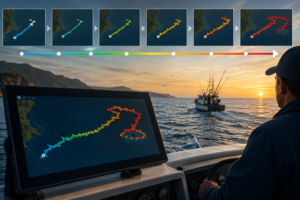
Genesis Live takes mapping further by building real-time 0.5-foot contour maps as you drive your boat. On lakes with outdated or low-resolution public charts, this can be a genuine game-changer, turning an unmapped stretch of water into a precision fishing zone over the course of a season.
Pros and Cons
Pros
Unbeatable value for live sonar. At $999.99, the Eagle Eye 9 is the only sub-$1,000 forward-facing sonar system on the market. The nearest competitor with similar technology costs at least $300–$500 more — and that’s before adding a separate head unit.
Module-free simplicity. One transducer, no black box, no Ethernet cable, no secondary module. Installation takes around 15 minutes with the included twist-lock connectors. Anglers who hate complex wiring jobs will appreciate this enormously.
Outstanding display. The 1000-NIT IPS screen is genuinely bright. Sunlight readability is excellent, and the IPS panel maintains image quality at angles — important when you’re standing in the boat or the unit is mounted off to one side.
Kayak and small-boat friendly. At under 2 lbs and 650 mA power draw, it places minimal demands on a small battery. It’s one of the few live sonar units realistically suited to a kayak setup.
C-MAP charts included. 17,000+ inland lakes preloaded means no extra cost for most freshwater anglers.
Power efficient. Draws approximately 75% less power than the Garmin Livescope system — a significant consideration for anglers on smaller batteries.
Cons
Live sonar range is limited. The Eagle Eye 9’s live sonar performs best under 40–50 feet and starts to degrade noticeably beyond 60–80 feet. Deep-water applications — offshore trolling, deep trout lakes, Great Lakes fishing — are beyond its optimal operating window.
Shallow-water noise. Some users report erratic or flickering readings in very shallow water (under 40 feet, particularly near heavy cover). Reducing sensitivity to around 60% typically resolves this, but requires some manual adjustment.
Transducer blind spot. Like all downward-facing transducer setups, there is a triangular dead zone directly below the hull. Slowly moving the boat forward reveals what’s in this zone.
Only 1-year base warranty. While a 5-year extension is available, it requires a paid upgrade. For a unit in this price range, a longer included warranty would be welcome.
No NMEA 2000 networking. Anglers wanting to tie the Eagle Eye into a multi-display network or connect to trolling motors via NMEA 2000 will find limitations here. It’s designed as a standalone unit.
Screen protector not included. The display is vulnerable to scratches — a screen protector should be considered an immediate additional purchase.
How Does the Lowrance Eagle Eye 9 Compare to Competitors?
vs. Garmin Livescope Plus (LVS34) — ~$1,499 system cost
Garmin’s Livescope remains the gold standard for live sonar image quality, especially in shallow water where its multi-beam transducer delivers unmatched clarity. It has a longer effective forward range and superior performance in murky conditions. However, the full system requires a compatible Garmin head unit (typically $800–$1,500 on its own) plus the Livescope module, for a total investment of $2,000–$3,000. The Eagle Eye 9 delivers roughly 75–80% of Livescope’s capability at one-third the price, making the value proposition very clear for non-tournament anglers.
vs. Humminbird MEGA Live — ~$2,200+ system cost
Humminbird’s MEGA Live offers impressive integration with Minn Kota trolling motors and Humminbird networking, plus a maximum range of 150 feet. Image quality is strong, though most field tests rate it slightly behind Livescope and Lowrance’s ActiveTarget at the top end. For anglers already invested in the Humminbird ecosystem, it makes sense — but for someone starting fresh, the Eagle Eye 9 is a fraction of the cost for similar shallow-water results.
vs. Lowrance ActiveTarget 2 — ~$1,500+ system cost
Lowrance’s own premium live sonar option uses six crystals vs. the Eagle Eye’s two, delivering wider coverage and better depth performance. If you’re fishing consistently in water deeper than 60 feet or want the widest possible live sonar field of view, the ActiveTarget 2 is worth the upgrade. For shallow-water fishing under 50 feet, the performance gap is narrower than the price gap suggests.
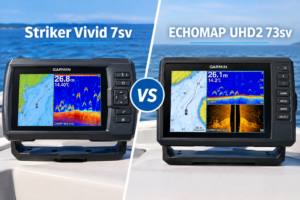
vs. Garmin Echomap UHD2 74cv — ~$650
For anglers who don’t specifically need live sonar, the Echomap UHD2 offers excellent CHIRP and ClearVü (DownScan-equivalent) quality, along with Garmin’s superb Navionics+ charts, at a lower price. However, it has no live sonar capability — once you fish with forward-facing sonar, going back is difficult.
What Customers Are Saying
Real-world feedback from verified purchasers paints a consistent picture: the Eagle Eye 9 exceeds expectations for its price point but has clear limitations that users should understand before buying.
“Shows fish clear as day in shallow water with minimal setup. The live sonar changed the way I fish bass tournaments. I was skeptical at this price but it genuinely works.” — Bass Pro Shops review
“Delivered quickly, worked right out of the box. Takes a couple of days on the water to get comfortable with all the views, but once you get it dialled in, you won’t fish without it.” — Walmart verified buyer
“Perfect for my kayak. Light, easy to mount, the battery barely notices it. FishReveal in the grass beds is absolutely deadly for crappie.” — Tackle Warehouse customer review
“The live sonar gets blurry after about 60 feet. For my shallow lake fishing that’s no problem at all, but if you’re deep-water trolling, look elsewhere.” — Wired2Fish forum user
“Phenomenal option for getting into forward-facing sonar for the first time. The price is unbeatable, setup is super simple, and the image quality surprised me.” — AguaPulse reviewer
The most common criticism centers on the live sonar depth limitation, which Lowrance is upfront about, and on occasional shallow-water interference, which is manageable with sensitivity adjustments.
Final Verdict: Who Should Buy the Lowrance Eagle Eye 9?
The Lowrance Eagle Eye 9 is the right unit for a very specific angler — and for that angler, it’s close to perfect. If you fish freshwater lakes and rivers in depths under 60 feet, target bass, crappie, walleye, or pike, and want live sonar without spending the equivalent of a used boat motor, this is your unit. It’s also an excellent entry point for kayak anglers who need something lightweight, low-power, and genuinely capable.
Where it falls short is equally clear. Deep-water applications, offshore use, complex multi-display networking, and demanding murky-water environments are better served by the Garmin Livescope, Humminbird MEGA Live, or Lowrance’s own ActiveTarget 2, all of which cost significantly more.
At $999, the Eagle Eye 9 is not a compromise product dressed up with marketing. It’s a genuinely functional live sonar system that democratises technology that was, until very recently, reserved for anglers with much deeper pockets. For the casual-to-intermediate angler who fishes inland waters, it may well be the best value in marine electronics available today.
Rating: 4.3 / 5
This article was created with AI assistance and reviewed by a human editor.
About The Author