For anyone standing a navigation watch, the space between the keel and the seabed is one of the few numbers that can never be estimated — it has to be known. Running aground doesn’t announce itself in advance, and by the time a hull scrapes bottom, the moment for prevention has already passed. This is where sonar and depth sounders earn their place as some of the most quietly essential instruments on any vessel, from a weekend cruiser to a deep-sea commercial ship.
This guide walks through sonar technology for sailors in plain terms: how it works, which type suits which kind of sailing, how to shop for a unit in 2026, and how to use it so it actually improves your situational awareness rather than just decorating the helm station.
Understanding Sonar Systems for Navigation
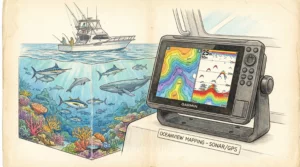
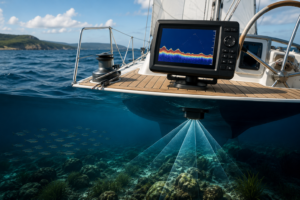
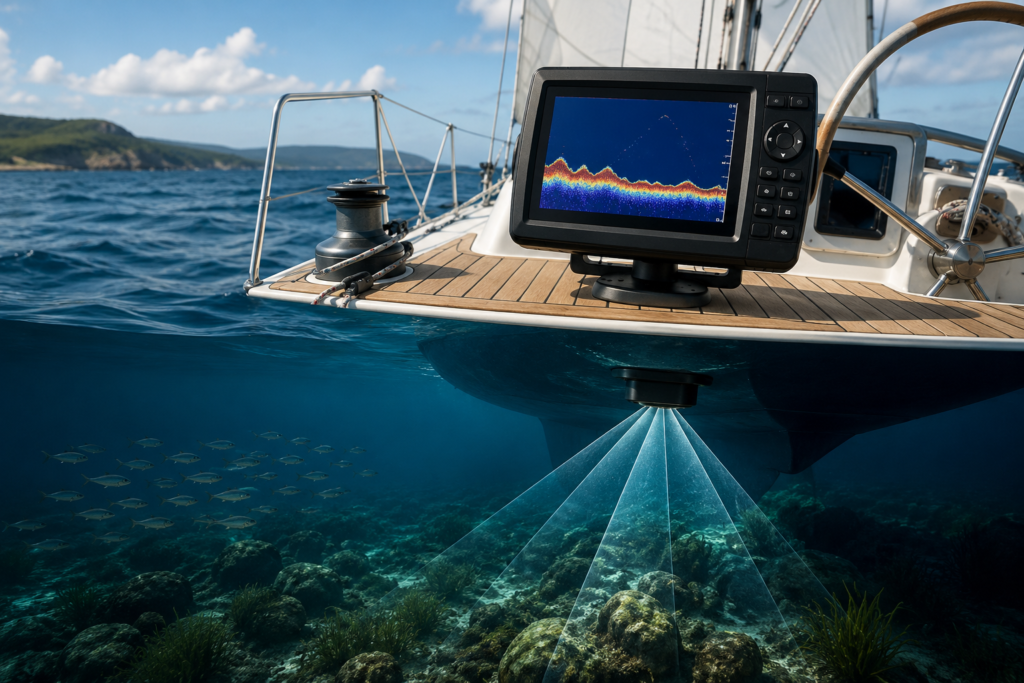
At its core, sonar (Sound Navigation and Ranging) works on a simple principle: a transducer mounted on the hull sends a sound pulse down through the water column. When that pulse hits the seabed or a fish, wreck, or rock ledge, it bounces back. The unit measures the time between the pulse leaving and the echo returning, and because sound travels through water at a known, fairly consistent speed, that time delay converts directly into a distance.
A basic depth sounder does exactly this on a single beam, straight down, and reports one number: the depth beneath the transducer. More advanced sonar systems widen that idea considerably. They can send multiple beams at different angles, use different frequencies to separate hard- and soft-bottom returns, or scan sideways rather than just downward. Understanding this underlying mechanism matters because it explains why different sonar types behave so differently in the same water, a topic worth unpacking before choosing equipment.
Two practical points worth remembering:
- Frequency and depth range are linked. Lower frequencies (50 kHz) penetrate deeper water but with less detail. Higher frequencies (200 kHz) provide sharper, more detailed readings but are less effective in very deep water.
- The reading is always relative to the transducer, not the keel or the waterline. Every sailor needs to know their own offset (more on this below) or risk a false sense of clearance.
Comparison of Sonar Types for Sailing
Not every sonar system is built for the same job. A quick comparison of sonar types for sailing helps clarify which technology fits which use case:
| Sonar Type | How It Works | Best For | Limitations |
|---|---|---|---|
| Single-beam | One straight-down pulse | Basic depth reading, small boats, tight budgets | No side detail, limited bottom composition data |
| Dual-beam | Two frequencies simultaneously | Slightly better bottom detail, moderate depths | Still narrow coverage area |
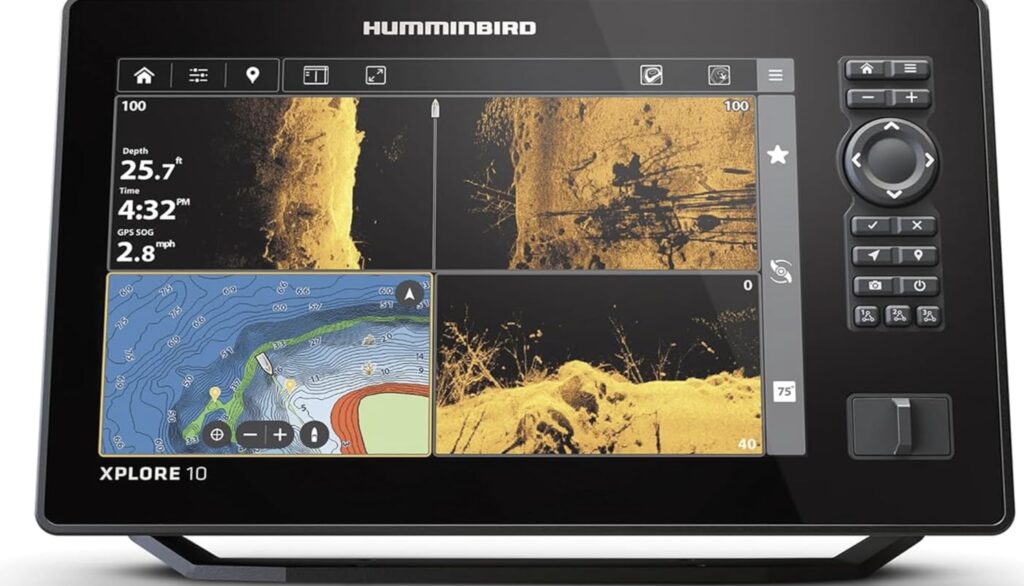
| CHIRP (Compressed High-Intensity Radiated Pulse) | Sweeps a range of frequencies per pulse | High-resolution target separation, deep and shallow water | Higher cost, more complex displays |
| Side-scan sonar | Sends beams outward to the sides of the vessel | Locating wrecks, structures, and bottom contour mapping | Doesn’t replace a straight-down depth reading |
| Down-scan sonar | Narrow, high-detail beam straight down | Identifying structure and fish arches with photo-like clarity | Narrower coverage than traditional sonar |
For most cruising and passage-making sailors, a CHIRP-based single- or dual-frequency system offers the best balance of accuracy and usability. Side-scan and down-scan units are more relevant to anglers and anyone doing detailed bottom or wreck survey work, though some cruisers use them for anchoring in unfamiliar coral or rock areas.
Depth Sounder Buying Guide 2026
Shopping for a new unit can be overwhelming given how much the category has expanded. This depth sounder buying guide 2026 focuses on the factors that actually affect performance on the water:
- Frequency range — Look for dual- or CHIRP-capable units that can shift between low and high frequencies depending on depth.
- Transducer type and mounting — Through-hull transducers give the most accurate readings but require haul-out installation. Transom-mount and in-hull “shoot-through” transducers are easier to retrofit but can lose accuracy at speed or in rough water.
- Display and networking — Modern units increasingly integrate into NMEA 2000 networks, allowing depth data to be displayed alongside GPS, AIS, and radar on a single multifunction display (MFD) rather than a standalone screen.
- Depth range and resolution — Coastal sailors rarely need extreme deep-water range; offshore passage-makers should prioritize units rated well beyond their expected maximum depths.
- Alarm functionality — Shallow-water and deep-water alarms are non-negotiable safety features, especially for solo or short-handed watches.
- Build quality and warranty — Marine electronics take a beating from salt, UV, and vibration; a two-year minimum warranty is a reasonable baseline expectation in 2026.
Affordable Depth Sounders for Sailing
Good depth-sounding equipment doesn’t have to break the budget. For sailors looking for affordable depth sounders for sailing, a few practical guidelines help:
- Entry-level single-frequency units from established marine electronics brands remain inexpensive and reliable for coastal and inland sailing where extreme depth range isn’t a concern.
- Combo GPS/depth units often cost less overall than buying a plotter and sounder separately, and they reduce clutter at the helm.
- Transom-mount transducers are the most budget-friendly installation option and are perfectly adequate for boats that don’t regularly sail at high heel angles or high speed.
- Watch for older-generation CHIRP units being discounted as manufacturers release newer models. Last year’s CHIRP technology remains excellent and is often available at a meaningful discount.
The key trade-off with budget units is usually screen size and network integration rather than core accuracy, which makes them a reasonable choice for sailors prioritizing function over features.
Best Sonar Apps for Sailors
Smartphone and tablet integration has changed how many sailors interact with depth data. Several of the best sonar apps for sailors now connect to portable, wireless sonar pucks or floating sensors that pair via Bluetooth or Wi-Fi, displaying live depth and bottom-contour data directly on a mobile device. These are particularly popular for:
- Dinghy sailors and small-boat owners without permanent electronics installations
- Chartering sailors who want personal depth data without relying solely on a charter boat’s fixed equipment
- Cruisers doing tender-based reconnaissance of an anchorage before bringing the main vessel in
While these apps are not a substitute for a properly installed marine sonar system on larger or offshore vessels, they’re a genuinely useful supplementary tool, particularly for scouting anchorages, checking depths at a dinghy landing, or cross-referencing an MFD’s readings.
Advanced Sonar Features for Sailors
Beyond basic depth readout, several advanced sonar features for sailors are worth understanding, even if not every sailor needs all of them:
- Bottom-lock and zoom functions that automatically keep the seabed centered on the display regardless of depth changes are useful when following a contour line.
- Structure ID and fish-arch discrimination were originally developed for anglers but are genuinely helpful for identifying wrecks, reefs, or debris.
- Forward-looking sonar (FLS), which projects soundings ahead of the vessel rather than only straight down — valuable in coral, reef, or shoaling areas where advance warning matters more than a reading directly beneath the keel.
- Networked multi-transducer setups, allowing forward, side, and downward sonar data to be fused into a single situational picture on an MFD.
- Historical depth logging, which builds a personal bathymetric record of frequently sailed waters over time — useful for local knowledge in areas where official charts may be outdated or based on older surveys.
How to Use Depth Sounders Effectively
Owning good equipment is only half the job. Knowing how to use depth sounders effectively is what actually prevents groundings:
- Calibrate the offset. Set the unit to read either from the waterline or from the keel — and know which one it’s set to. A sounder reading “true depth beneath keel” behaves very differently from one reading “depth beneath transducer” when you’re planning clearance in skinny water.
- Account for the tide. A depth sounder shows the water depth right now, not the charted depth at datum. Cross-reference readings with tide tables, especially in areas with large tidal ranges.
- Watch for false bottoms. Dense weed beds, thermoclines, and even large schools of fish can sometimes reflect sound, producing a false or “soft” bottom reading above the actual seabed.
- Set alarms before you need them. A shallow-water alarm set only after you’ve noticed the depth dropping is a warning system that arrived too late.
- Reduce speed in uncertain water. Faster speeds can introduce turbulence and aeration near transom-mounted transducers, degrading reading quality exactly when accuracy matters most.
- Cross-check against the chart, always. Sonar tells you what’s beneath you right now; it doesn’t tell you what’s ahead. Charts, local knowledge, and visual pilotage remain essential companions to any sonar reading.
Best Practices for Using Sonar
Bringing it all together, these best practices for using sonar apply across recreational and professional sailing alike:
- Treat sonar as one input among several, chart, GPS, visual lookout, and local knowledge, never as a sole source of truth for navigation decisions.
- Inspect and clean transducers regularly; marine growth is one of the most common causes of degraded or erratic readings.
- Keep firmware and chart data on networked systems up to date, particularly on units that integrate bathymetric data with GPS plotting.
- Train every crew member who might stand a watch to read and interpret the depth display correctly, including alarm settings and offset configuration.
- Log unusually shallow or unexpected readings in the ship’s log; over time, this builds valuable local knowledge that supplements official charts.
Final Thoughts
Sonar and depth-sounding technology have moved a long way past the simple single-beam units of a generation ago, but the underlying discipline hasn’t changed: know your equipment, understand its limitations, and never let a screen replace good seamanship. Whether you’re outfitting a small cruiser with a budget-friendly unit or running a networked CHIRP system on a passage-making yacht, the goal is the same: clear, reliable awareness of what lies beneath the keel, at every point in the passage.
This article was created with AI assistance and reviewed by a human editor.
About The Author